












Last Watched

"Hunt"  Sort by

Humpback Whale

   2006    Nature
Few sounds are more beautiful or moving than the underwater songs of the humpback whale. Male whales compete with their songs, which often last for 10 minutes at a time, and can be repeated for hours on end. Whales separated by thousands of miles of sea will sing almost identical songs. Researchers have found that the songs change throughout the breeding months, following a mysterious pattern repeated across the waves. Whales also use sound to hunt. To catch herring, humpback whales release a stream of bubbles to form a shimmering, circular fishing net. Emitting a repetitive loud scream, they scare the fish into a tight ball, then lunge out of the water to swallow the shoal whole. Now it seems that the long-held image of the gentle giant must change to one of a ferocious and opportunistic hunter.
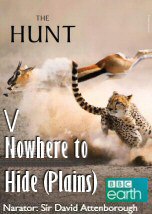
Nowhere to Hide

   2015    Nature
The open arenas of grassland and desert make up half of all land on our planet. In these exposed habitats, predators like cheetahs, bald eagles and lions can usually see their prey. But it works both ways: their prey can see them too. With nothing but open vistas, the element of surprise is hard-won, and predators must make their own opportunities.
Series: The Hunt

Jaguar Jungle

   2020    Nature
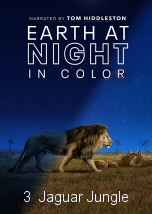
A jaguar fights to keep his river home in Brazil as the night brings both challenges and opportunities to hunt. Evening is falling in the world's greatest tropical wetland, Brazil's Pantanal. A stronghold for South America's most secretive big cat, the jaguar. And enjoying the last warmth of the day is a male known as Juru. At six years old and weighing over 100 kilos, he's amongst the largest, most powerful big cats in the Americas. This prime stretch of river has been his territory for two years. But tonight Juru's reign hangs in the balance. In a recent fight with a rival male, he badly injured his paw. It's left him weak and hungry. The coming days and nights will test him more than ever before. He'll need to summon the strength to defend his river.
Series: Earth at Night in Color

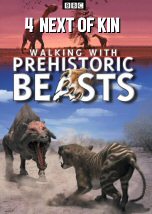
Next of Kin

       Science
Moving on to Ethiopia 3.2 million years ago, we witness the beginnings of mankind via a group of australopithecus - a type of ape which, like us, walks upright on two legs. But unlike us, these early members of the human family weren't predators, they were prey. Things get worse for the group as they are hunted by a sabre-tooth cat called dinofelis and fall victim to other dangers such as malaria, rival australopithecus and a rampaging 14-tonne deinotherium.
Series: Walking with Prehistoric Beast

Mammoth Journey

       Science
Travelling forward in time to 30,000 years ago, it's the middle of an ice age. The landscape is dominated by mighty mammoths, living side-by-side with woolly rhinos, giant deer and two separate species of human. The programme follows the fate of a herd of mammoths in their annual struggle against the harsh ice-age conditions. Every summer they spend on the grassy plains of what will one day become the bottom of the North Sea, but every winter they are forced to head for the less exposed valleys further south. It is a journey fraught with danger: mammoths can get trapped in frozen bogs, and the herd must run the gauntlet of hunters like cave lions and the deadly Neanderthals.
Series: Walking with Prehistoric Beast

The Power of Doubt

   2017    History
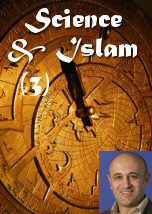
In the last episode, Al-Khalili turns detective, hunting for clues that show how the scientific revolution that took place in the 16th and 17th centuries in Europe had its roots in the earlier world of medieval Islam. He travels across Iran, Syria and Egypt to discover the huge astronomical advances made by Islamic scholars through their obsession with accurate measurement and coherent and rigorous mathematics.He then visits Italy to see how those Islamic ideas permeated into the west and ultimately helped shape the works of the great European astronomer Copernicus, and investigates why science in the Islamic world appeared to go into decline after the 16th and 17th centuries, only for it to re-emerge in the present day. Al-Khalili ends his journey in the Royan Institute in the Iranian capital Tehran, looking at how science is now regarded in the Islamic world
Series: Science and Islam