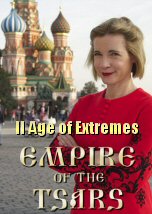
Lucy Worsley continues her journey through Russia in the footsteps of the Romanovs, the most powerful royal dynasty in modern European history. In this episode she examines the extraordinary reign of Catherine the Great, and the traumatic conflict with napoleonic France that provides the setting for the novel War and Peace. At the magnificent palace of Peterhof near St Petersburg, Lucy charts the meteoric rise of Catherine the Great, who seized the Russian throne from her husband Peter III in 1762 and became the most powerful woman in the world. Catherine was a woman of huge passions - for art, for her adopted country (she was German by birth) and for her many lovers. Catherine expanded her empire through military victories overseas, while at home she encouraged education and introduced smallpox inoculation to Russia. But Catherine struggled to introduce deeper reforms, and the institution of serfdom remained largely unchanged. Lucy explains how this injustice fuelled a violent rebellion. Nevertheless, Catherine left Russia more powerful on the world stage than ever. But all she had achieved looked set to be undone when Napoleon invaded Russia in 1812. Lucy relives the pivotal battle of Borodino, when the Russian army finally confronted the French forces; the traumatic destruction of Moscow; and, under Catherine's grandson Alexander, the eventual victory over the French that provided the Romanov dynasty with its most glorious hour.
The world of the armoured creatures is equally fascinating and bizarre. Galapagos giant tortoises solve the problem of making love in a suit of armour; a heated sea turtle orgy leaves females in mortal danger and we witness the explosive arrival of a baby pig-nosed turtle. Giant salt-water crocodiles crowd a flooded river-run to fish for mullet and a caiman leads her brood in a touching trek to a communal crèche.
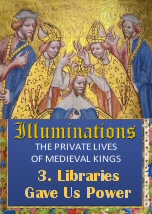
The story of the British Library's Royal Manuscripts collection reaches its end with the last great flowering of illumination, in the magnificent courts of the Tudors. Dr Janina Ramirez investigates astrological texts created for Henry VII, and unwraps his will - still in its original, extravagantly-decorated velvet and gold cover. She hears music written for Henry VIII, which went unperformed for centuries; and reads love notes between the king and Anne Boleyn, written in the margins of a prayer book. Nina also visits Bruges, the source of many of the greatest manuscripts, where this medieval art form collided with the artistic innovations of the Renaissance.
'Every show is different. When the lights go down that's 30,000 people's lives colliding... for that one moment. Everyone that's there working or watching is there for that moment. It's when you're all kind of in agreement about what you're all doing at that time... so it's a wonderful feeling of togetherness and possibility Then I start getting real adrenaline... and start doing 'Rocky' shadow boxing and all that kind of stuff. So I get as excited as anyone else. And I still get that excitement when I go and see anyone else's concert. I love that moment. And then it's about trying to hold that energy for an hour and a half... because it can go if you're not careful Whilst it might not be perceived as cool to be really enthused by the fact that people show up to hear your music... we don't really give a f***, we really love that and it's exciting, you know?'
Three weeks before the official launch date of the new album 'inFinite' of rock legend Deep Purple CineStar presents the accompanying film 'From Here To InFinite' on the big screen. The exclusive cinema premiere of the film, which offers captivating insights into the genesis of the upcoming studio album, took place on March 16,, 2017. In addition, fans can hear for the first time and world-exclusive three songs from this new album.
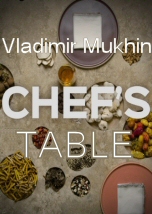
A powerful depiction of Vladimir Mukhin's struggle to resuscitate an almost forgotten russian cuisine, going against the established tradition. Be prepared for stunning images of culinary creations at White Rabbit, some will leave you uneased. A fifth-generation chef, Mukhin worked in his father’s kitchen as a young man, preparing Soviet-era classics. So, like generations of youths before him, Mukhin had to rebel against the old man. He left his small hometown of Essentuki for Moscow and became obsessed with modern techniques and food from across Europe. It wasn’t until he worked as a sous chef in France, when he collaborated on a menu with chef Christian Etienne, that Mukhin realized Russian cuisine could exist within modern cooking. 'His French clients who ate it were amazed,' he says. ¡They loved his Russian cooking.'

















Catherine expanded her empire through military victories overseas, while at home she encouraged education and introduced smallpox inoculation to Russia. But Catherine struggled to introduce deeper reforms, and the institution of serfdom remained largely unchanged. Lucy explains how this injustice fuelled a violent rebellion. Nevertheless, Catherine left Russia more powerful on the world stage than ever. But all she had achieved looked set to be undone when Napoleon invaded Russia in 1812. Lucy relives the pivotal battle of Borodino, when the Russian army finally confronted the French forces; the traumatic destruction of Moscow; and, under Catherine's grandson Alexander, the eventual victory over the French that provided the Romanov dynasty with its most glorious hour.