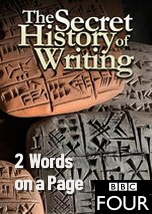
Writing itself is 5,000 years old, and for most of that time words were written by hand using a variety of tools. The Romans were able to run an empire thanks to documents written on papyrus. Scroll books could be made quite cheaply and, as a result, ancient Rome had a thriving written culture. With the fall of the Roman Empire, papyrus became more difficult to obtain. Europeans were forced to turn to a much more expensive surface on which to write: Parchment. Medieval handwritten books could cost as much as a house, they also represent a limitation on literacy and scholarship. No such limitations were felt in China, where paper had been invented in the second century. Paper was the foundation of Chinese culture and power, and for centuries how to make it was kept secret. When the secret was out, paper mills soon sprang up across central Asia. The result was an intellectual flourishing known as the Islamic Golden Age. Muslim scholars made discoveries in biology, geology, astronomy and mathematics. By contrast, Europe was an intellectual backwater. That changed with Gutenberg’s development of movable type printing. The letters of the Latin alphabet have very simple block-like shapes, which made it relatively simple to turn them into type pieces. When printers tried to use movable type to print Arabic texts, they found themselves hampered by the cursive nature of Arabic writing. The success of movable type printing in Europe led to a thousand-fold increase in the availability of information, which produced an explosion of ideas that led directly to the European Scientific Revolution and the Industrial Revolution that followed.
Mark has never had a girlfriend, but he wants love more than anything. Maddi and Mark are going on their second date at the Australian Museum. Olivia has had 'a bazillion' unrequited loves but is not ready to give up. Maddi dates a new man who impresses her with his musical talent.
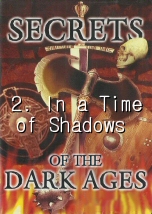
On the second part of his journey through the dark ages Richard Rudgley continues into the age of the wandering peoples, the Volkerwanderung. These Northern people enjoyed a golden age unaffected by Rome and just 30 years after the Romans relinquished Britain, the 'Anglo-Saxons' made their move. The bedraggled legions are in retreat. Walls are pulled down. Mosaics shattered. And yet there never was a people called Anglo-Saxon. We look at the lasting influence of Saxon leaders like Alfred the Great, and his blue print for social justice.
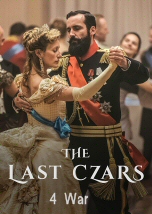
In 1914, Russia entered World War I in response to Austria-Hungary's declaration of war on Russia's ally Serbia. This was fought across multiple fronts while isolated from its allies. The Battle of Tannenberg, where the entire Russian Second Army was annihilated, cast an ominous shadow over the empire's future. The already-existing public distrust of the regime was deepened by the rising costs of the war and rumours of corruption. World War I takes Nicholas to the front. Back home, outrage grows over high casualties and Alexandra and Rasputin's political intrigues.
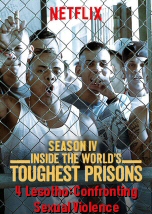
Lesotho's Maseru Central Correctional Institute in Southern Africa holds the country's most dangerous and disturbed criminals. Shockingly almost half the inmates are doing time for rape. The culture of sexual violence in Lesotho has deep roots in society. Women are taken as secondary citizens in their culture. And sexual aggression continues inside the prison. In this episode, Raphael Rowe will spend a week locked up in this African prison surrounded by sex offenders.
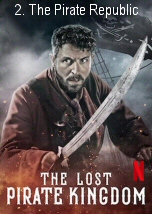
There had been other pirate settlements in different places but none of them had worked quite the same way that Nassau did. There was a fort there. People stayed, they built a community on the land. Larger and larger numbers of pirate-minded people were showing up there and starting to develop an economy around themselves. Men like Edward Thatch, later known as Blackbeard, his sidekick, Black Caesar, a former slave, and the pied pirate that led them all there, Captain Benjamin Hornigold. In the second episode, tensions rise between Benjamin Hornigold and Henry Jennings; their rivalry takes a new direction when Hornigold declares Nassau a pirate republic.












No such limitations were felt in China, where paper had been invented in the second century. Paper was the foundation of Chinese culture and power, and for centuries how to make it was kept secret. When the secret was out, paper mills soon sprang up across central Asia. The result was an intellectual flourishing known as the Islamic Golden Age. Muslim scholars made discoveries in biology, geology, astronomy and mathematics. By contrast, Europe was an intellectual backwater.
That changed with Gutenberg’s development of movable type printing. The letters of the Latin alphabet have very simple block-like shapes, which made it relatively simple to turn them into type pieces. When printers tried to use movable type to print Arabic texts, they found themselves hampered by the cursive nature of Arabic writing. The success of movable type printing in Europe led to a thousand-fold increase in the availability of information, which produced an explosion of ideas that led directly to the European Scientific Revolution and the Industrial Revolution that followed.