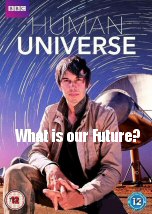
Professor Brian Cox concludes his exploration of our place in the universe by asking what next for the ape that went to space. Our future is far from certain. In Florida, Brian joins the latest efforts to protect Earth from potential catastrophic events. He joins a team of Nasa astronauts who are training for a future mission to an asteroid - should we ever discover one coming our way - under 30 feet of water in a submerged laboratory that simulates space. It is just one example of how, for our long-term survival, space exploration may well be vital. It is a view shared by Apollo 16 astronaut Charlie Duke, who tells Brian what it was like to escape the confines of the planet. It is a dream that both Nasa and now commercial companies share as they race to get humans back into deep space. But space travel, like every leap our civilisation has ever made, requires energy. Here too, scientists are hard at work attempting to safeguard our future. At the National Ignition Facility in California, Brian witnesses the world's most successful fusion experiment in action. He believes that if their mission succeeds, our civilisation will have unlocked a way to the stars that will not destroy the planet in the process. Brian concludes by returning to the top of the world in Svalbard, where he gains access to our civilisation's greatest treasure, locked away in a vault buried deep in the permafrost.
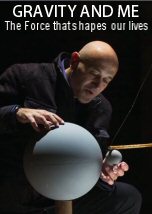
Professor Jim Al-Khalili investigates the amazing science of gravity. A fundamental force of nature, gravity shapes our entire universe. It sculpts galaxies and warps space and time. But gravity’s strange powers also affect our daily lives in the most unexpected ways. This is a story with surprises in store for Jim himself. In telling the story of gravity, his own understanding of the nature of reality comes to be challenged. Finally, Jim discovers that, despite incredible progress, gravity still has many secrets to unveil.
Stonehenge was shaped over centuries, but to what purpose? Was it a temple to the sun, or the moon, an astronomical calendar, or a shrine to dead ancestors? Now Stonehenge may be about to give up some of its secrets. For the first time in nearly half a century a new archaeological dig the sacred stone circle. And the men who are leading the excavation are well aware of the significance of this moment. The film exposes an investigation into a radical theory that Stonehenge, far from being a place of burial as is commonly assumed, was in fact a place of healing. The investigation takes in forensic testing of bones excavated over the past decades and hard-won permission for the first dig in 50 years at the Henge, watched live online by millions of viewers around the world. Does the theory of the healing stones bear up to modern-day forensic science?
Discover the Eras of the Universe and the answer to this big question: When Will Time End? Once the notion that the universe started with a rapid inflation nicknamed the Big Bang became accepted by the majority of scientists, many possible fates are predicted by rival scientific hypotheses, including futures of both finite and infinite duration.
The ultimate fate of the universe is dependent on the shape of the universe and what role Dark energy will play as the universe ages.
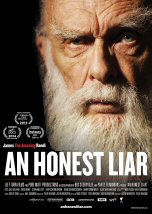
A feature documentary about the world-famous magician, escape artist, and world-renowned enemy of deception, James 'The Amazing' Randi. The film brings to life Randi's intricate investigations that publicly exposed psychics, faith healers, and con-artists with quasi-religious fervour. A master deceiver who came out of the closet at the age of 81, Randi created fictional characters, fake psychics, and even turned his partner of 25 years, the artist Jose Alvarez, into a sham guru named Carlos. But when a shocking revelation in Randi's personal life is discovered, it isn't clear whether Randi is still the deceiver - or the deceived.
Psychopaths have long captured the public imagination. Painted as charismatic, violent predators lacking in all empathy, they provide intrigue and horror in equal measure. But what precisely is a psychopath? What is it that drives them to cause harm, even kill? And can they ever be cured? The film also features a series of candid interviews with prison inmates who not only describe their crimes but why they think they committed them. 'What Makes a Psychopath?' explores not only how each individual's crimes were shaped by their own life experiences, but also gives an insight into how these people think and behave. Working with the world's experts in the field, the film sheds light on the biological, psychological and environmental influences that shape a psychopath. And it looks to the future, with ground-breaking research that suggests a lifetime of incarceration is not the only option to manage violent and dangerous psychopaths.

















But space travel, like every leap our civilisation has ever made, requires energy. Here too, scientists are hard at work attempting to safeguard our future. At the National Ignition Facility in California, Brian witnesses the world's most successful fusion experiment in action. He believes that if their mission succeeds, our civilisation will have unlocked a way to the stars that will not destroy the planet in the process. Brian concludes by returning to the top of the world in Svalbard, where he gains access to our civilisation's greatest treasure, locked away in a vault buried deep in the permafrost.