We are the generation of human beings that are going to know whether or not we're alone in the universe. This episode explores the search of exoplanets, from ancient Greek philosophers to the discoveries made possible with the Kepler Telescope. Unbelievable new worlds, planets made of diamond, planets of raining glass, worlds in collision, some plunging into stars, and others that just might harbor life. Thanks to today's planet hunters, our views of the universe and of our place in it are undergoing one of the greatest revolutions in scientific history.
The fake story of the art found beneath the depths of the ocean from a 2,000 year old ship wreck. Damien Hirst and the crew recount the moments various discoveries are made, the myths and legends surrounding the find.
They defined music and popular culture like no other band ever will - but how did The Beatles make the journey from Merseyside teenagers to international pop stars in the 1960s? Made on Merseyside - The Beatles discovers how American rock 'n' roll and rhythm and blues dragged post-war Liverpool into one of the most vibrant music cities ever with the Mersey Sound. Featuring revealing interviews from those involved in the early years of The Beatles in Liverpool and Hamburg and unique archive, the incredible story of The Beatles' previous band formations and why it took so long for them to achieve success makes riveting viewing. From school bands, to colleges; Hamburg to The Cavern Club, The Beatles changed the world of pop music forever, but was Pete Best's sacking from the band and Ringo's replacement the final part of the jigsaw?
Frequent security expos feature companies like Megvii and its facial- recognition technology. They show off cameras with A.I. that can track cars, and identify individuals by face, or just by the way they walk. In China it's been projected that over 600 million cameras will be deployed by 2020. Here, they may be used to discourage jaywalking, but they also serve to remind people that the state is watching. Matching with the most advanced artificial intelligence algorithm, they can actually use this data, real-time data, to pick up a face or pick up a action. A.I. is a technology that can be used for good and for evil. So, how do governments limit themselves in, on the one hand, using this A.I. technology and the database to maintain a safe environment for its citizens, but not to encroach on a individual's rights and privacies?
Almost everything we know today about the beautiful giant ringed planet comes from Cassini, the NASA mission that launched in 1997 and arrived at Saturn in 2004. Since then, the space probe has been beaming home miraculous images and scientific data, revealing countless wonders about the planet, its rings and 62 moons - including some that could harbor life. When the mission approached its final days, it attempted one last set of daring maneuvers - diving between the innermost ring and the top of Saturn's atmosphere. Aiming to skim less than 2000 miles above the cloud tops, no spacecraft has ever gone so close to Saturn, and hopes were high for incredible observations that could solve major mysteries about the planet's core. But such a daring maneuver comes with many risks and is no slam dunk. In fact, slamming into rocks in the rings is a real possibility. Join NASA engineers for the tense and triumphant moments as they find out if their bold re-programming has worked, and discover the wonders that Cassini has revealed over the years.
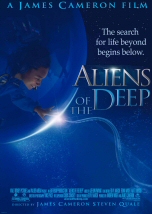
James Cameron journeys to some of the Earth's deepest, most extreme and unknown environments in search of the strange and alien creatures that live there. Joining him is a team of young NASA scientists and marine biologists who consider how these life forms represent life we may one day find in outer space not only on distant planets orbiting distant stars, but also within our own solar system. Aliens of the Deep is the result of expeditions to several hydrothermal vent sites in the Atlantic and the Pacific. These are violent volcanic regions where new planet is literally being born and where the interaction between ocean and molten rock creates plumes of super-heated, chemically-charged water that serve as oases for animals unlike anything ever discovered. Six-foot tall worms with blood-red plumes and no stomach, blind white crabs, and a biomass of shrimp capable of 'seeing' heat all compete to find just the right location in the flow of the super-heated, life-giving water or to fry.



















Thanks to today's planet hunters, our views of the universe and of our place in it are undergoing one of the greatest revolutions in scientific history.