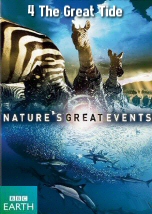
A mighty army of dolphins, sharks, whales, seals and gannets hunt down the billions of sardines along South Africa's east coast each winter. This is the Sardine Run: an underwater Armageddon, the greatest gathering of predators anywhere on the planet, and the most spectacular event in the world's oceans. From intimate moments of the creatures caught up in the run, to the dramatic finale of this spectacular event, The Great Tide is an action-packed feeding-frenzy, filmed underwater, on the ocean's surface, and in the air. However, in recent years the sardine run has become less predictable, perhaps due to the warming effects of climate change. If the sardine run does not happen, the lives of the animals caught up in the drama hang in the balance. Pioneering a unique boat stabilised camera mount for surface filming, Nature's Great Events crew capture all the high octane action as the predators compete for sardines, filmed with aerial, underwater and above water cameras. Super slow motion cameras also capture the very moment gannets plunge into the water, hitting it at sixty miles an hour. A violent winter storm is the trigger for the sardines to begin their desperate dash. They are followed by a super-pod of 5,000 dolphins and further up the coast more predators gather. A shoal of sardines 15 miles long is pushed into the shallows and aerial shots show thousands of sharks gathering to feed on them. The climax to the sardine run is a spectacular feeding frenzy as the dolphins round the sardines up into balls on which all the predators feast. Gannets rain down in their thousands, sharks pile in scattering the fish and a Bryde's whale lunges in taking great mouthfuls of sardines.
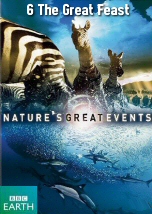
Every summer in the seas off Alaska humpback whales, sea lions and killer whales depend on an explosion of plant life, the plankton bloom. It transforms these seas into the richest on Earth. But will these animals survive to enjoy the great feast? The summer sun sparks the growth of phytoplankton, microscopic floating plants which can bloom in such vast numbers that they eclipse even the Amazon rainforest in sheer abundance of plant life. Remarkably, it is these minute plants that are the basis of all life here. But both whales and sea lions have obstacles to overcome before they can enjoy the feast. Humpback whales migrate 3,000 miles from Hawaii, and during their 3 month voyage lose a third of their body weight. In a heart-rending scene a mother sea lion loses her pup in a violent summer storm, while another dramatic sequence shows a group of killer whales working together to kill a huge male sea lion. In late summer the plankton bloom is at its height. Vast shoals of herring gather to feed on it, diving birds round the fish up into a bait ball and then a humpback whale roars in to scoop up the entire ball of herring in one huge mouthful. When a dozen whales work together they employ the ultimate method of co-operative fishing - bubble net feeding. One whale blows a ring of bubbles to engulf the fish and then they charge in as one. Filmed from the surface, underwater and, for the first time, from the air, we reveal how these giant hunters can catch a tonne of fish every day.
Changing diets and dramatic price swings have put dairy farmers on the ropes and fueled a surge in lucrative but controversial raw milk sales. Proponents of raw milk have stated that there are benefits to its consumption, including better flavour, better nutrition, and the building of a healthy immune system. However, the medical community has warned of the dangers, which include a risk of infection, and has not found any clear benefit
Yep, the Dennis Rodman episode. The eccentric forward shows his worth on the floor while stirring up drama away from it, including a wild midseason trip to Las Vegas. Rodman's attitude and energy help the team win. The Bulls struggle to push past the 'Bad Boy' Pistons, losing to Detroit in the 1988, 1989 and 1990 playoffs. There is no love lost between the Eastern Conference rivals.
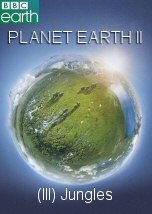
Jungles provide the richest habitats on the planet - mysterious worlds of high drama where extraordinary animals attempt to survive in the most competitive place on earth. Flooded forests are home to caiman-hunting jaguars and strange dolphins that swim amongst the tree tops, while in the dense underworld, ninja frogs fight off wasps and flying dragons soar between trees. Acrobatic indri leap through the forests of Madagascar, while the jungle night conceals strange fungi and glow-in-the-dark creatures never filmed before.
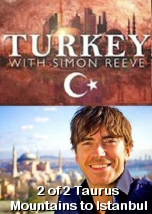
In the Taurus Mountains Simon stays with descendants of the original Turks, nomads known as Yoruks, whose lifestyle is under threat from the modern world and an increasingly religious government. They're not the only minority at odds with the authorities in Turkey; Simon sees first-hand the devastating effects of fighting in the country's Kurdish region. In an area where the government has detained foreign journalists, Simon gathers unique footage in the aftermath of a crackdown on Kurdish militants - the wholesale destruction of the historic centre of one of Turkey's oldest cities. Away from the conflict in the south, Simon heads towards the Black Sea coast. He meets a wildlife conservationist protecting Turkey's population of brown bears, and villagers who still communicate over long distances using an ancient bird language. In the country's capital he meets a victim of President Erdogan's authoritarian purge of people accused of complicity in the failed coup against him. Finally Simon's journey comes full circle when he returns to Istanbul - home to the new craze of 'Ottomania', a celebration of the vast empire that preceded modern Turkey. Simon visits the set of one of the world's most popular TV dramas - even getting a speaking role - based in the court of an Ottoman sultan




















However, in recent years the sardine run has become less predictable, perhaps due to the warming effects of climate change. If the sardine run does not happen, the lives of the animals caught up in the drama hang in the balance. Pioneering a unique boat stabilised camera mount for surface filming, Nature's Great Events crew capture all the high octane action as the predators compete for sardines, filmed with aerial, underwater and above water cameras. Super slow motion cameras also capture the very moment gannets plunge into the water, hitting it at sixty miles an hour.
A violent winter storm is the trigger for the sardines to begin their desperate dash. They are followed by a super-pod of 5,000 dolphins and further up the coast more predators gather. A shoal of sardines 15 miles long is pushed into the shallows and aerial shots show thousands of sharks gathering to feed on them. The climax to the sardine run is a spectacular feeding frenzy as the dolphins round the sardines up into balls on which all the predators feast. Gannets rain down in their thousands, sharks pile in scattering the fish and a Bryde's whale lunges in taking great mouthfuls of sardines.