


Last Watched

"Bit"  Sort by

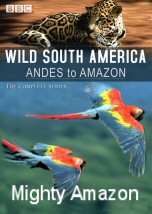
Mighty Amazon

   2005    Nature
A look at the unique habitat which is formed every year when the Amazon floods an area of forest the size of England. It creates a world that is home to turtles, caiman and giant otters, and where fish fly through the air and dolphins hunt amongst the tree tops.
Series: Wild South America
Edge of Space

   2009    Technology
Low Earth Orbit, 120 miles above sea level, is where the majority of space exploration has occurred. This 1,100 mile band around Earth is where--for a cool $20 million--any private citizen can take the vacation of his or her life on the International Space Station. Commercial prospects for LEO are huge; but dangers lurk for any individual willing to travel here--radiation, cosmic rays, and space debris numbering in the thousands threaten any spacecraft travelling in orbit. It's the new frontier, or the final frontier...and the possibilities are endless if you are willing to travel to the edge of space exploration.
Series: The Universe

The Electric Boy

   2014    Science
This episode provides an overview of the nature of electromagnetism, as discovered through the work of Michael Faraday. Tyson explains how the idea of another force of nature, similar to gravitational forces, had been postulated by Isaac Newton before. Tyson continues on Faraday, coming from poor beginnings, would end up becoming interested in studying electricity after reading books and seeing lectures by Humphry Davy at the Royal Institution. Davy would hire Faraday after seeing extensive notes he had taken to act as his secretary and lab assistant. After Davy and chemist William Hyde Wollaston unsuccessfully tried to build on Hans Christian Ørsted's discovery of the electromagnetic phenomena to harness the ability to create motion from electricity, Faraday was able to create his own device to create the first electric motor by applying electricity aligned along a magnet. Davy, bitter over Faraday's breakthrough, put Faraday on the task of improving the quality of high-quality optical glass, preventing Faraday from continuing his research. Faraday, undeterred, continued to work in the Royal Institution, and created the Christmas Lectures designed to teach science to children. Following Davy's death, Faraday returned to full time efforts studying electromagnetism, creating the first electrical generator by inserting a magnet in a coil of wires. Tyson continues to note that despite losing some of his mental capacity, Faraday concluded that electricity and magnetism were connected by unseen fields, and postulated that light may also be tied to these forces. Using a sample of the optical glass that Davy had him make, Faraday discovered that an applied magnetic field could affect the polarization of light passing through the glass sample (a dielectric material), leading to what is called the Faraday effect and connecting these three forces. Faraday postulated that these fields existed across the planet, which would later by called Earth's magnetic field generated by the rotating molten iron inner core, as well as the phenomena that caused the planets to rotate around the sun. Faraday's work was initially rejected by the scientific community due to his lack of mathematical support, but James Clerk Maxwell would later come to rework Faraday's theories into the Maxwell's equations that validated Faraday's theories. Their combined efforts created the basis of science that drives the principles of modern communications today.
Series: Cosmos: A Spacetime Odyssey

Free for All

   2013    Art
Part 2 examines how the freewheeling modernism that had shocked audiences in the first two decades of the century came under state control. Initially, many practitioners thought the totalitarian regimes would be good for music and the arts. What followed in Germany was a ban on music written by Jews, African-Americans and communists, while in the Soviet Union there was a prohibition on music the workers were unable to hum. After the cataclysm of the 1940s, a new generation of composers - Boulez, Stockhausen, Xenakis, Nono, Ligeti - turned their back on what they saw as the discredited music of the past and tried to reinvent it from scratch. Or, at least, from serialism, which became as much of a straitjacket as totalitarianism's strictures had been. But from this period of avant-garde experimentation, which many listeners found baffling and terrifying, came some of the most influential and radical musical innovations of the century.
Series: The Sound and the Fury

Footsteps in the Snow

   1993    History
This episode discusses the human exploration of Antarctica, in particular the mission led by Captain Robert Falcon Scott, whose team died on the way back from the South Pole. It shows the scientific work in the modern human bases in Antarctica, especially Mawson Base and its observation of Adelie Penguins (partially through tracking devices). The second half of the episode describes how the series was made. Most crucial was of course the camera work. To get access to the wildlife of the sea, for example, boats, divers, suspended capsules and remotely controlled cameras mounted on inflatables were used. Particularly dangerous to divers were Leopard Seals and other predators. The film concludes that although working in Antarctica is now much easier than during the early days of exploration, human footsteps on the continent are still exceedingly rare in part because of international treaties prohibiting industrial exploitation.
Series: Life in the Freezer

March to June

   2014    Nature
In this final episode we complete our journey, travelling back from the March equinox to the end of June. Kate Humble is in the Arctic at a place where spring arrives with a bang, whilst Helen Czerski chases a tornado to show how the earth's angle of tilt creates the most extreme weather on earth.
Series: Orbit: Earth Extraordinary Journey
Prehistoric Planet

Prehistoric Planet

2022  Science
The Sky at Night

The Sky at Night

2023  Science
Earthflight

Earthflight

2012  Nature
The Story of Maths

The Story of Maths

2008  Science
Trainwreck

Trainwreck

2025  History
Through the Wormhole

Through the Wormhole

2011  Science
Myths and Heroes

Myths and Heroes

2005  History
The Last Czars

The Last Czars

2019  History