



Last Watched

"EMI"  Sort by

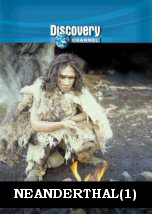
Neanderthal 1

       History
Long ago, two species of human beings coexisted on Earth until competition drove one of them to extinction. This program, set in the southwest of France 35,000 years ago, reconstructs the life in the Neanderthal world at the time Cro-Magnons first entered the scene. All aspects of Neanderthal clan life are examined, including tool- and weapon-making, hunting and gathering, health and healing, childbirth, rituals, and making fire. Footage of skeletal remains and the scholarly research of eminent paleontologist Chris Stringer and Oxford University's Paul Pettitt support the documentary.
Series: Neanderthal

Erasing Dad

   2014    Culture
It tells the stories of six fathers separated from their children after a conflicting divorce and the difficulties to maintain the link with their children. Contains critical material regarding the functioning of the courts and alleges unequal treatment of the couples in conflict. The film had its premiere scheduled for 2014 but was suspended. The Argentinean judge Guillermo Blanch ordered producers to refrain from any transmission and / or retransmission of images or videos without the consent referrals of several people interviewed." The famous journalist and psychologist Liliana Hendel says in the documentary 'is difficult for a woman deviseth that she was beated, or their children, or that he does not give money or any form of violence'... 'the opposite of what usually happens, that any citizen is innocent until it is proven otherwise, I believe that in situations of domestic violence, cause the scale of the problem the burden of proof must be reversed. That is, if I say that he is guilty, he is guilty until proven innocent'. The Argentinean deputy Gladys González argue the documentary supports Parental Alienation Syndrome, a entity that does not exist and it has not been recognized by any health institution in the world, and with the deputy Cornelia Schmidt-Liermann signed a statement rejecting the SAP in the Chamber of Deputies

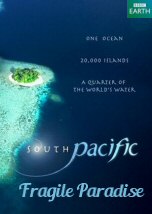
South Pacific Fragile Paradise

   2009    Nature
The extraordinary wildlife, culture and history of this immense, fascinating ocean and its myriad islands are revealed in stunning detail. With its coral reefs, turquoise lagoons and dramatic oceanic atolls, the South Pacific is the archetypal paradise. It is still relatively healthy and teeming with fish, but it is a fragile paradise. International fishing fleets are taking a serious toll on the sharks, albatross and tuna, and there are other insidious threats to these bountiful seas. We look at what is being done to preserve the ocean and its wildlife.

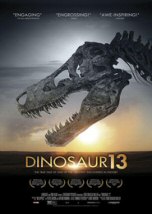
Dinosaur 13

   2014    Science
American paleontologist Pete Larson and his team discovered the largest and most complete Tyrannosaurus rex ever found (nicknamed 'Sue') while digging in the badlands of South Dakota. However the skeleton was seized from Larson by the federal government, followed by a ten-year-long battle with the FBI, the National Park Service, the Bureau of Indian Affairs, and Maurice Williams, on whose property the bones were discovered. Pete Larson also spent 18 months in prison." After the film aired, The Society of Vertebrate Paleontology, a society of professional academic paleontologists, issued a statement of full support for legally protecting fossils on public land and criticized Dinosaur 13 for implying that government regulations impede paleontological science

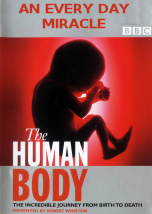
An Everyday Miracle

   1998    Medicine
This series, presented by Robert Winston, takes us on a journey from birth to death using time-lapse photography, computer graphics and various state-of-the-art imaging techniques to explore every aspect, every nook and crevice of the human body in its various stages of growth, maturity and eventual decay. Though heart-warming in that it shows the commonality of human experience, The Human Body is also a potentially depressing reminder of our frail physicality and mortality." In this episode, follow Jeff and Phillippa from conception to the birth of their first child Bob in An Everyday Miracle. Learn why conception is the most dangerous part of your life, and the struggles that you must go through to even reach the first step. The couple openly discuss their concerns and joy throughout their entire pregnancy and this episode in particular would be well worth viewing by those who are expecting their first child. From experience, this tasteful and informative section captures aspects of pregnancy that the hospital-run Maternity Classes don't explain as well. You even get to see the birth of their child which makes for a great lead into the next section. And in case you were wondering, every day there are around 100 million acts of sexual intercourse taking place in the world resulting in around 910,000 conceptions.
Series: The Human Body

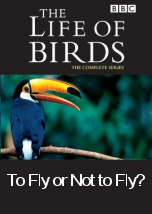
To Fly or Not to Fly

   1998    Nature
The first episode looks at how birds first took to the skies in the wake of the insects. It begins in Mexico, where Sir Attenborough observes bats being outmanoeuvred by a red-tailed hawk. Pterosaurs were the birds' forerunners, some 150 million years after dragonflies developed the means of flight, but eventually went extinct together with the dinosaurs. Birds had by then already evolved from early forms like archaeopteryx, the first creature to possess feathers. Its ancestry can be traced through reptiles, and some current species, such as the flying lizard, possibly show paths this evolution may have taken." One of the biggest birds to have ever existed was the terror bird, which proliferated after dinosaurs vanished and stood up to 2.5 metres tall. By comparison, the ostrich, while not closely related, is the largest and heaviest living bird. It was probably the evasion of predators that drove most birds into the air, so their flightless cousins evolved because they had few enemies. Accordingly, such species are more likely to be found on islands, and Sir Attenborough visits New Zealand to observe its great variety, most especially the kiwi. Also depicted is the moa, another huge creature that is now gone. The takahē is extremely rare, and high in the mountains of New Zealand, Sir Attenborough discovers one from a population of only 40 pairs. Finally, another example on the brink of extinction is the kakapo, which at one point numbered only 61 individuals. A male is heard calling — an immensely amplified deep note that can be heard at great distances from its nest.
Series: The Life of Birds
The Cell

The Cell

  Science
Leaving Neverland

Leaving Neverland

2019  Culture
Asia

Asia

2024  Nature
Rome

Rome

  History
Trainwreck

Trainwreck

2025  Culture
Human

Human

2025  History
Future Warfare

Future Warfare

2021  Technology