












Last Watched

"Evolution"  Sort by

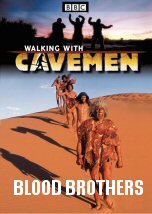
Walking with Cavemen: Blood Brothers

   2003    History
'Blood Brothers' follows the lives of two species, Paranthropus boisei and Homo habilis who embody two alternative ways of ape-man life. Although heavyset, with distinctive gorilla-like faces, the boisei are gentle characters. They live within a strict social structure and are led by a dominant male whose strength and power holds the group together. The habilis have taken a different approach to survival. They don't have the specialisms of the boisei but instead have developed into the archetypal jack-of-all-trades, inquisitive scavengers prepared to try almost anything to survive. Tough, active, gregarious and noisy, they are always on the move and always alert to the possibility of a meal. But in the near drought of the dry season the habilis are struggling. It seems as if their way of life cannot help them when conditions are tough.
Series: Walking with Cavemen

The Real Garden of Eden

   2011    Culture
Can we find the Garden of Eden? Bible scholar Dr Francesca Stavrakopoulou thinks so. In the final episode of her series re-examining conventional readings of the Bible, she argues that the Garden of Eden has nothing to do with the origins of humanity, but is rather a story concealing dramatic events about a particular figure in a particular place, two and half thousand years ago. Marshalling compelling evidence from archaeology, Islam and the Bible text itself, she identifies and visits the exact site of Eden. It's a revolutionary theory which challenges some of the most cherished preconceptions about Eden in both Christianity and western culture.
Series: Bible's Buried Secrets

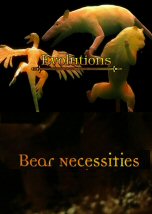
Bear Necessities

   2008    Science
One animal embodies all that is amazing about survival. It has adapted to wildly varying habitats and evolved unique weapons of survival; its greatest asset is its ferocious bite and it is evolutions ultimate survivor, but what species is it? Find out if a new bear species could be about to evolve before our very eyes.
Series: Evolutions

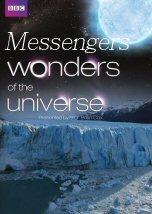
Messengers

   2011    Science
Professor Brian Cox travels from the fossils of the Burgess Shale to the sands of the oldest desert in the world to show how light holds the key to our understanding of the whole universe, including our own deepest origins. To understand how light holds the key to the story of the universe; you first have to understand its peculiar properties. Brian considers how the properties of light that lend colour to desert sands and the spectrum of a rainbow can lead to profound insights into the history and evolution of our universe. Finally, with some of the world's most fascinating fossils in hand, Brian considers how but for an apparently obscure moment in the early evolutionary history of life, all the secrets of light may have remained hidden. Because although the universe is bathed in light that carries extraordinary amounts of information about where we come from, it would have remained invisible without a crucial evolutionary development that allowed us to see. Only because of that development can we now observe, capture and contemplate the incredible wonders of the universe that we inhabit.
Series: Wonders of the Universe

Enemy of the State

   2010    Technology
Here, Aleks charts how the Web is forging a new brand of politics, both in democracies and authoritarian regimes. With contributions from Al Gore, Martha Lane Fox, Stephen Fry and Bill Gates, Aleks explores how interactive, unmediated sites like Twitter and YouTube have encouraged direct action and politicised young people in unprecedented numbers. Yet, at the same time, the Web's openness enables hardline states to spy and censor, and extremists to threaten with networks of hate and crippling cyber attacks.
Series: The Virtual Revolution

Can We Make Life

   2018    Medicine
'It's alive!' Since Dr. Frankenstein spoke those famous words, we've been alternately enthralled and terrified by the idea of creating life in the lab. Now, a revolution in genetic engineering and thrilling innovations in synthetic biology are bringing that dream—or nightmare, as the case may be—closer to reality. New tools allow researchers to use cells to create their own DNA and edit it into existing genomes with more ease and less cost than ever before.
Along with renewed hopes for treating some genetic diseases, there's serious talk of using the newest technologies to bring long-extinct animals back from the dead – like the team hoping to resurrect the woolly mammoth. Science fiction is quickly becoming science fact. Another daring genetic experiment to bioengineer animals could prevent Lyme disease. But the power to make life comes with deep ethical questions. What are the potential rewards—and dangers—of tinkering with nature? This films explores the benefits and the burden of risk surrounding the controversial new technology.
Series: Nova Wonders
Generation Iron

Generation Iron

2018  History
Leaving Neverland

Leaving Neverland

2019  Culture
Chemistry

Chemistry

2010  Science
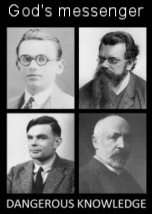
Dangerous knowledge

Dangerous knowledge

2007  Science
Solar System

Solar System

2024  Science