





Last Watched

"Travel"  Sort by

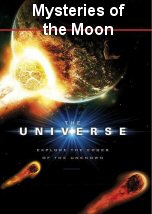
Mysteries of the Moon

   2007    Science
For thousands of years, mankind has found comfort in its presence. It's been a lantern for nighttime travellers, a timekeeper for farmers and a location finder for sailors at sea. For some cultures, it's even been a god. It's the only cosmic body ever visited by human beings. From afar, the Moon's luminance has captivated us since the beginning of time. And a closer look at the beacon in the dark sky reveals an ever-present source of myth, intrigue, controversy and unsolved mysteries. The field of science may cast an empirical light on some things about the Universe, but lunar experts are the first to admit they don't have all the answers when it comes to our Moon. This episode explores the theories behind Lunar Transient Phenomena that have left scientists stumped for centuries; takes to the Canadian waters to see how the Moon effects our planet through tides; and dusts off some age-old myths and weighs arguments that without our Moon, humanity may not even exist.
Series: The Universe
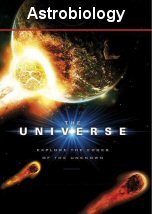
Astrobiology

   2008    Science
Does life exist on other planets? Astrobiology is a visionary new science that searches for life in space by combining the disciplines of astronomy, biology and geology. How did life evolve on Earth? What will life look like on other planets? These and other pertinent questions will be answered by a diverse group of scientists. Viewers will visit the Pilbara region of West Australia where the oldest evidence of life on Earth has been discovered. Travel to the moons of Jupiter and Saturn to test a theory that life could exist in the clouds of Venus. Finally, watch as experiments are done to see if life exists on exoplanets, earth-like planets beyond our solar system.
Series: The Universe

Space Travel

   2008    Technology
When man finally broke free of the Earth's gravitational pull the dream of travelling to other planets became a reality. Today scientists are proposing a bizarre array of technologies in the hope of travelling faster through space: from space craft sporting sails that catch laser beams, to propulsion engines powered by a bizarre entity known as anti-matter. Finally explore the science behind the seemingly fanciful notion of warp-drive and a theoretical particle that can travel faster than light.
Series: The Universe

Unexplained Mysteries

   2008    Science
Explore the myths, misconceptions, truths & amazing mysteries of our unique universe. Could life exist on Mars? Is time travel possible & does Einstein's theory of relativity support it?
Series: The Universe

Edge of Space

   2009    Technology
Low Earth Orbit, 120 miles above sea level, is where the majority of space exploration has occurred. This 1,100 mile band around Earth is where--for a cool $20 million--any private citizen can take the vacation of his or her life on the International Space Station. Commercial prospects for LEO are huge; but dangers lurk for any individual willing to travel here--radiation, cosmic rays, and space debris numbering in the thousands threaten any spacecraft travelling in orbit. It's the new frontier, or the final frontier...and the possibilities are endless if you are willing to travel to the edge of space exploration.
Series: The Universe

Travellers Tales

   1980    Science
The journeys of the Voyager probes is put in the context of the Netherlands in the seventeenth century, with a centuries-long tradition of sailing ship explorers, and its contemporary thinkers (such as Constantijn Huygens and his son Christian). Their discoveries are compared to the Voyager probes' discoveries among the Jovian and Saturn systems. In Cosmos Update, image processing reconstructs Voyager’s worlds and Voyager’s last portrait of the Solar System as it leaves is shown.
Series: Cosmos