






Last Watched

"EMI"  Sort by

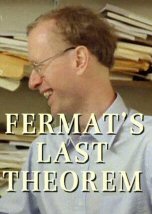
Fermat Last Theorem

   1996    Science
The Pythagorean Theorem is simple: x2 + y2 = z2. In this form, the equation can be solved. But what if the 2 is replaced with any positive integer greater than 2? Would the equation still be solvable? More than 300 years ago, amateur mathematician Pierre de Fermat said no, and claimed he could prove it. Unfortunately, the book margin in which he left this prophecy was too small to contain his thinking. Fermat's Last Theorem has since baffled mathematicians armed with the most advanced calculators and computers. Andrew Wiles methodically worked in near isolation to determine the proof for this seemingly simple equation.
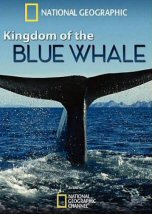
Kingdom of the Blue Whale

   2009    Nature
Blue whales are the largest animals to ever live on earth, yet they are difficult to find or track. Even some of the locations where they birth their young are great secrets. Join some of the world's eminent blue whale scientists as they embark on a revolutionary mission to identify and tag California blue whales as they migrate to a spot known as the Costa Rica Dome. This incredible voyage yields unforgettable new footage and insight into these amazing creatures' lives. Scientists use DNA analysis, recordings of whale songs, homing devices, and sea dives to shed light on the blue whale's breeding and birthing habits

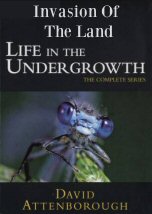
Life in the Undergrowth: Invasion Of The Land

   2005    Nature
Open your eyes to the bizarre, ferocious and surprisingly beautiful world of the invertebrates, a ground-breaking exploration into a spectacular miniature universe never normally seen but teeming all around us. In the first episode, the story of the land-living invertebrates. Discover the private life of Europe's dramatic leopard slug, a common garden resident with a truly bizarre end to its marathon mating ritual; watches the courtship ballet of tiny springtails on the underside of a leaf; sees swarms of bright red South African millipedes find partners, and in the caves of Venezuela meets the giant bat-eating centipede.
Series: Life in the Undergrowth

Why Do Viruses Kill

   2010    Medicine
The world stood in fear of an emerging new disease that threatened to kill millions. A new flu variant H1N1 had arrived. If this latest pandemic has taught anything, it is just how little is understood about the invisible world of viruses. But that has not stopped scientists trying. Horizon follows the leading researchers from across the world, who are attempting to unravel the many secrets of viruses to understand when and why they kill.

Why are Thin People not Fat

   2009    Medicine
The world is affected by an obesity epidemic, but why is it that not everyone is succumbing? Medical science has been obsessed with this subject and is coming up with some unexpected answers. As it turns out, it is not all about exercise and diet. At the centre of this programme is a controversial overeating experiment that aims to identify exactly what it is about some people that makes it hard for them to bulk up.

Allergy Planet

   2008    Medicine
We are in the grip of an allergy epidemic. 50 years ago one in 30 were affected, but in Britain today it is closer to one in three. Why this should be is one of modern medicine's greatest puzzles. In search of answers, Horizon travels round the globe, from the remotest inhabited island to the polluted centres of California and the UK. We meet sufferers and the scientists who have dedicated their lives trying to answer the mystery of why we are becoming allergic to our world.
Life

Life

2009  Nature
Bronze Age

Bronze Age

2016  History
The Life of Mammals

The Life of Mammals

2002  Nature
The Reluctant Traveler

The Reluctant Traveler

2023  Culture
Rafa

Rafa

2026  History
Clarkson Farm

Clarkson Farm

2021  Nature