




Last Watched

"IS"  Sort by

Unexplained Mysteries

   2008    Science
Explore the myths, misconceptions, truths & amazing mysteries of our unique universe. Could life exist on Mars? Is time travel possible & does Einstein's theory of relativity support it?
Series: The Universe
Wildest Weather in the Cosmos

   2008    Science
Imagine a tornado so powerful, it can form a planet, or winds sweeping across a planet but blowing at 6,000 miles per hour! How about rain....made of iron? Sounds like science fiction, but this type of weather is occurring daily in our solar system. Scientists are just beginning to unlock the secrets of these planets and their atmospheres. Can this research help scientists solve long unanswered questions that we have about Earth? As our own planet churns with the effects of global warming, it's natural to look into the heavens and wonder about the rest of the real estate.
Series: The Universe

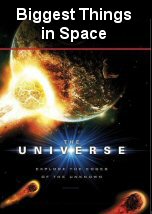
Biggest Things in Space

   2008    Science
We can't compare anything on earth to the biggest things known in space. The Cosmic Web may connect objects in the universe with threads of Dark Matter. The Lyman-alpha blob is a bubble like structure containing countless galaxies--perhaps the biggest object in the entire universe. Regions of radio-emitting gas called "radio lobes" could be even bigger. Then there are super galaxy clusters which are hundreds of galaxies merged together due to cosmic collisions. Discover which is the largest planet, star, star cluster, constellation, black hole, volcano, galaxy, explosions, moon, storm, impact crater and "void" in space.
Series: The Universe

Gravity

   2008    Science
Gravity is the most powerful and exacting force in the universe. It is pervasive and penetrating. Gravity binds us together, its reach hangs stars in the sky and its grip crushes light. Gravity holds planets together, and leashes them to their suns. Without gravity, stars, comets, moons, nebulae, and even the Earth itself would not exist. Explore how science and humanity discovered, overcame and utilized gravity. Learn what it takes to propel objects into the heavens, to ride a wave or to ski down a slope. Take a front row seat as an astronaut subjects himself to the weightless wonders of the specially modified aircraft used to train astronauts known as the "Vomit Comet."
Series: The Universe

Edge of Space

   2009    Technology
Low Earth Orbit, 120 miles above sea level, is where the majority of space exploration has occurred. This 1,100 mile band around Earth is where--for a cool $20 million--any private citizen can take the vacation of his or her life on the International Space Station. Commercial prospects for LEO are huge; but dangers lurk for any individual willing to travel here--radiation, cosmic rays, and space debris numbering in the thousands threaten any spacecraft travelling in orbit. It's the new frontier, or the final frontier...and the possibilities are endless if you are willing to travel to the edge of space exploration.
Series: The Universe

Heaven and Hell

   1980    Science
Sagan discusses comets and asteroids as planetary impactors, giving recent examples of the Tunguska event and a lunar impact described by Canterbury monks in 1178. It moves to a description of the environment of Venus, from the previous fantastic theories of people such as Immanuel Velikovsky to the information gained by the Venera landers and its implications for Earth's greenhouse effect. The Cosmos Update highlights the connection to global warming.
Series: Cosmos
Rise of Empires: Ottoman

Rise of Empires: Ottoman

2020  History
Trainwreck

Trainwreck

2025  History
Big Oil vs The World

Big Oil vs The World

2022  Nature
Explained

Explained

2018  Technology
Our Planet

Our Planet

2019  Nature
Clash of the Gods

Clash of the Gods

2009  History
Engineering the Future

Engineering the Future

2022  Technology