The last episode examines the fragile interdependence that exists between forests' wide variety of residents, including bald eagles, hunting dogs and Siberian tigers. Over half of all the world's trees, evergreen and deciduous, stand in great assemblies. For many of us, they are places of mystery and darkness. They are key to our climate, and home to countless unique species. The boreal forest contains 750 billion trees, and it stores over 40 percent of the world's carbon, making it a vital element in the fight against climate change. In the past, we have destroyed them without hesitation. Yet, forests do have an astonishing ability to recover. If we choose to give forests time and space, they could reclothe the earth with much of the rich and varied communities of animals and plants of which we have, so recently, robbed it. A future with more forests is key to the resilience of our planet.
Mark has never had a girlfriend, but he wants love more than anything. Maddi and Mark are going on their second date at the Australian Museum. Olivia has had 'a bazillion' unrequited loves but is not ready to give up. Maddi dates a new man who impresses her with his musical talent.
The third assault on the tattered remains of Roman civilization came from even further North, where the melting glacial ice had created immense sheltered fjords, leaving its inhabitants little choice but the sea. These fearless navigators understood that dominion over the oceans was the key to their ambitions. Where the Romans expanded incrementally, the Vikings adopted a bolder, more aggressive approach. So was it the Dark Age which failed Europe, or the stifling uniformity of the great Roman experiment? Were the lost tribes more victim than failure? Richard Rudgley will hope to shed new light on the real secrets of the so-called Dark Age.
Grasslands cover one quarter of all land and support the vast gatherings of wildlife, but to survive here animals must endure the most hostile seasonal changes on the planet. From Asia's bizarre-looking Saiga antelope to the giant anteaters of Brazil, grassland animals have adapted in extraordinary ways to cope with these extremes. In the flooded Okavango, lions take on formidable buffalo in epic battles, on the savannah bee-eaters take advantage of elephants to help catch insects and, on the freezing northern tundra, caribou embark on great migrations shadowed by hungry Arctic wolves.
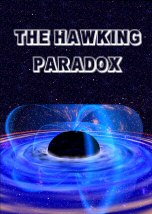
Does the universe, have a limit? Does the universe have an edge? Looking out to the edge of the universe is tremendously important to understand our place in the cosmos and to understand the universe itself. Inflation was a formative moment for our universe. By the time it stopped, the universe's basic characteristics were set. There could be regions of the greater universe where inflation didn't stop then. Occasionally a little region will stop inflating and just expand at the normal rate. We could imagine a super large-scale structure where there's different regions of the universe, domains, and each domain has different local constants and laws of physics.
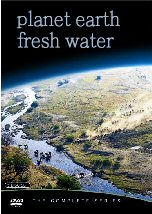
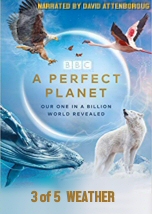
Weather controls the distribution of freshwater on Earth. David Attenborough narrates how this uneven distribution has given rise to an incredible diversity of species and habits, from the driest desert to the lushest tropical rainforest. Featuring a colony of ants banding together into a raft every time its home in the Amazon floods, a rain frog that manages to eke out an existence in one of the world's driest habitats on Earth, and the last wild camels that survive the Gobi Desert's bitter winters by eating snow that blows in from Siberia.














Over half of all the world's trees, evergreen and deciduous, stand in great assemblies. For many of us, they are places of mystery and darkness. They are key to our climate, and home to countless unique species. The boreal forest contains 750 billion trees, and it stores over 40 percent of the world's carbon, making it a vital element in the fight against climate change. In the past, we have destroyed them without hesitation. Yet, forests do have an astonishing ability to recover. If we choose to give forests time and space, they could reclothe the earth with much of the rich and varied communities of animals and plants of which we have, so recently, robbed it. A future with more forests is key to the resilience of our planet.