




Last Watched

"Bit"  Sort by

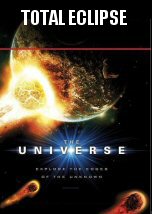
Total Eclipse

   2010    Science
Once they were dreaded and thought to be dragons eating the sun--but modern science has dispelled mythology and we now look forward to total Solar Eclipses as one of the most spectacular phenomena in the heavens. Explore the complex movements of Earth, Moon and Sun that produce these unusual events and hear details why we may be the only intelligent beings in the known Universe to witness eclipses like we see on Earth. Man-made eclipses also figure into the science in the form of instruments called "coronagraphs." They blot out the sun and reveal its corona, uncovering secrets which, while enlightening, also warn of a disaster that could make our advanced technology crash and burn. Finally, travel into deep space, where the tiny eclipses caused by planets circling distant stars is now beginning to reveal hundreds more stars where "exoplanets" exist... perhaps even those in habitable zones like the Earth.
Series: The Universe
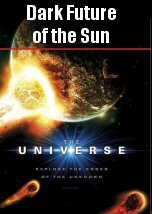
Dark Future of the Sun

   2010    Science
Our Sun has served Earth well for almost five billion years. It's bathed us with heat and energy. But like humans, our home star is mortal. In five billion years, it will stop nurturing its planetary offspring. The aging star will bloat out beyond the orbit of our planet incinerating all living things--including humans if we're still around.
Series: The Universe

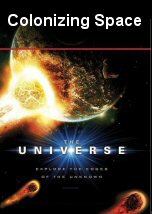
Colonizing Space

   2008    Technology
Space colonization is no longer the fodder of science fiction, it is becoming a reality. Examine the efforts underway to establish a human colony on Mars, including how they plan to grow food, recycle wastewater and introduce greenhouse gases to revive the red planet and make it more habitable for humans. Cutting-edge computer graphics are used to bring the universe down to earth to show what life would be like on Mars, and to imagine what kind of life forms might evolve in alien atmospheres.
Series: The Universe

Neptune and Uranus

   2011    Science
Uranus and Neptune: The 'ice giants'. Strap yourselves in for an incredible voyage to the most remote and intriguing planets of all. There has never been a better time to boldly go where no human has gone before to follow in the footsteps of our robot pioneers and visit the planets of the Solar System. Ever wanted to be an astronaut? Imagine heading into the Ice Zone, the frigid, dark realm beyond the orbit of Saturn. So far from the Sun, you wouldn't expect much to be happening here. From orbit, Uranus appears sedate and calm. But why is the planet on its side? And Neptune: The second blue planet, and the last world in our Solar System. But something is driving its wild winds. And what about its Great Dark Spot? this planet just changes its spots. Leopards don't, but Neptune does.
Series: A Traveler Guide to the Planets

When Knowledge Conquered Fear

   2014    Science
The episode begins with Tyson describing how pattern recognition manifested in early civilization as using astronomy and astrology to predict the passing of the seasons, including how the passage of a comet was often taken as an omen. Tyson continues to explain that the origin of comets only became known in the 20th century due to the work of Jan Oort and his hypothesis of the Oort cloud. Tyson then continues to relate the collaboration between Edmond Halley and Isaac Newton in the last part of the 17th century in Cambridge. The collaboration would result in the publication of Philosophiæ Naturalis Principia Mathematica, the first major work to describe the laws of physics in mathematical terms, despite objections and claims of plagiarism from Robert Hooke and financial difficulties of the Royal Society of London. Tyson explains how this work challenged the prevailing notion that God had planned out the heavens, but would end up influencing many factors of modern life, including space flight. Tyson further describes Halley's contributions including determining Earth's distance to the sun, the motion of stars and predicting the orbit of then-unnamed Halley's Comet using Newton's laws. Tyson contrasts these scientific approaches to understanding the galaxy compared to what earlier civilizations had done, and considers this advancement as mankind's first steps into exploring the universe. The episode ends with an animation of the Milky Way and Andromeda galaxies' merging based on the principles of Newton's laws.
Series: Cosmos: A Spacetime Odyssey

Artic

   2009    Nature
The Russian Arctic is one of the world’s most extreme habitats, yet it is a haven for polar bears, lemmings, arctic foxes and walruses. In late August, massive muskoxen bulls gather together to compete for mating dominance. Each bull can weigh 400 kilogram’s and charge at a speed of 40 kilometres an hour; a head-to-head impact can be heard more than a kilometre away
Series: Wild Russia
Hidden Kingdoms

Hidden Kingdoms

2014  Nature
Leaving Neverland

Leaving Neverland

2019  Culture
Long Way Up

Long Way Up

2020  Culture
Love On The Spectrum

Love On The Spectrum

2019  Culture
Sonic Highways

Sonic Highways

2014  Art
Warrior Graveyard

Warrior Graveyard

  History
Natural World

Natural World

2015  Nature
Dangerous knowledge

Dangerous knowledge

2007  Science