














Last Watched

"Evolution"  Sort by

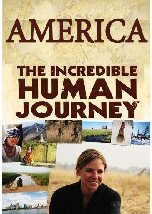
The Incredible Human Journey: America

   2009    History
Alice Roberts tries to find out how Stone Age people reached North and South America for the first time. She finds out about an ancient corridor through the Canadian ice sheet that might have allowed the first humans through. Old finds in Chile though point to a whole different route for the first humans making it there.
Series: The Incredible Human Journey

The Story of India: The Power of Ideas

   2007    History
Michael Wood’s epic series moves on to the revolutionary years after 500BC - the Age of the Buddha. Travelling by rail to the ancient cities of the Ganges plain, by army convoy through Northern Iraq, and on down the Khyber Pass, he shows how Alexander the Great’s invasion of India inspired her first empire.
Series: The Story of India

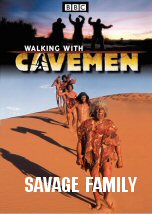
Walking with Cavemen: Savage Family

   2003    History
One and a half million years ago, a new breed of ape-man walks the land. In southern Africa, Homo Ergaster has taken the next step to becoming human. They have long, modern looking noses, which cool air as they breathe. Their hairless bodies, with millions of tiny sweat glands, mean they don't pant anymore to control their temperature - they sweat. And, above all, they have big brains - nearly two-thirds the size of ours.
Series: Walking with Cavemen

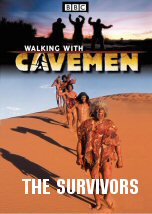
Walking with Cavemen: The Survivors

   2003    History
Nearly half a million years ago, the most advanced human yet roams Europe. Strong and powerful, Homo heidelbergensis are fierce hunters, use sophisticated tools and live in close-knit family groups. Over 200,000 years they become split into two populations by extremes of weather and environment and evolve separately into two very different species. In the North are the Neanderthals, whose physical power and resilience is the key to surviving in ice age Northern Europe. About 140,000 years ago, Africa is in the grip of a devastating drought, and something remarkable has happened to the descendants of heidelbergensis who live there. The combination of environment and chance has bred in them a unique ability that will change the course of human history. It will be this small band of southern survivors, perhaps numbering just a few tens of thousands, who will come to dominate the world and be known as Homo sapiens.
Series: Walking with Cavemen

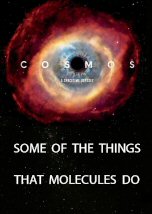
Some of the Things That Molecules Do

   2014    Science    HD
The story begins with Tyson sitting at a campfire, and telling how the wolf changed through artificial selection, and selective breeding into the dog breeds around today. He then enters the Ship of Imagination, and explains natural selection with the process that helped to create the polar bears. Along the way he talks about DNA, genes and mutation. Next he goes to a forest and describes the Tree of life, this leads him to discussing the evolution of the eye. He then discusses extinction, by going to a monument called the Halls of Extinction, dedicated to the broken branches of the tree of life. Explaining the five great Extinction events. He then tells how some life has survived, and then focuses on the tardigrade. From there he talks about what other kinds of life might have been created on other worlds. He then goes to Saturn's moon Titan. From there he speculates about life and how it first began. He then returns to Earth and tells about abiogenesis and how life changed and evolved. The show ends with an animated sequence from the original series of life's evolution from one cell to humans.
Series: Cosmos: A Spacetime Odyssey

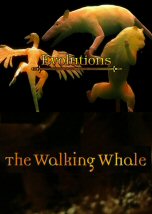
Evolutions: The Walking Whale

   2008    Science
This series illuminates unique and bizarre evolutionary journeys that have brought forth some of the world’s most impressive animals. We unearth a 50-million-year-old mystery mammal sought out a new source of food in the water, starting a spectacular evolutionary journey so that today it looks like a fish. How did a creature built for land become master of the ocean?
Series: Evolutions