






Last Watched

"Nim"  Sort by

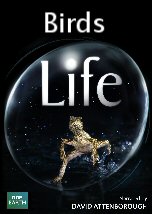
Life: Birds

   2009    Nature
Birds owe their global success to feathers - something no other animal has. They allow birds to do extraordinary things. For the first time, a slow-motion camera captures the unique flight of the marvellous spatuletail hummingbird as he flashes long, iridescent tail feathers in the gloomy undergrowth. Aerial photography takes us into the sky with an Ethiopian lammergeier dropping bones to smash them into edible-sized bits. Thousands of pink flamingoes promenade in one of nature's greatest spectacles. The sage grouse rubs his feathers against his chest in a comic display to make popping noises that attract females. The Vogelkop bowerbird makes up for his dull colour by building an intricate structure and decorating it with colourful beetles and snails.
Series: Life
Mountains

   2006    Nature
Welcome to an extreme landscape of rock, ice and snow. We tour the mightiest mountain ranges, starting with the birth of a mountain at one of the lowest places on Earth and ending at the summit of Everest. Find out how some of the most secretive animals rise to the challenge of mountain life. Share one of Earth's rarest phenomena, a lava lake that has been erupting for over 100 years. The same forces built the Simian Mountains where we find troops of gelada baboons nearly a thousand strong. In the Rockies, grizzlies build winter dens inside avalanche-prone slopes and climb the peaks to devour abundant summer moths. In another world first, the programme brings us astounding images of a snow leopard hunting on the Pakistan peaks.
Series: Planet Earth

Freshwater

   2007    Nature
Fresh water is our most precious resource and it defines the distribution of life on land. Follow the descent of rivers from their mountain sources to the sea. Watch spectacular waterfalls, fly inside the Grand Canyon and explore the wildlife below the ice in the world's deepest lake. Witness unique and dramatic moments of animal behaviour: a showdown between smooth-coated otters and mugger crocodiles; deep-diving long tailed macaques; massive flocks of snow geese on the wing and a piranha frenzy in the perilous waters of the world's largest wetland.
Series: Planet Earth

The Jungles

   2006    Nature
Jungles cover roughly three per cent of our planet yet contain 50 per cent of the world's species. High-definition cameras enable unprecedented views of animals living on the dark jungle floor. In the Ngogo forest the largest chimpanzee group in the world defends its territory from neighbouring groups. Other jungle specialists include parasitic fungi which infiltrate an insect host, feed on it, and then burst out of its body.
Series: Planet Earth

Edge Of The Ice

   2003    Nature
Journey through the long-vanished corners of prehistoric North America, beginning when man first entered the vast, unspoiled continent some 14,000 years ago, in this appealing BBC documentary. Witness ancient beasts, mammoths, mastodons, giant bears, and sabre-toothed cats, and see the legacies each has passed to their modern successors. Computer animation and digital effects bring to life mammoths, saber-toothed cats, giant ground sloths, short-faced bears, glyptodonts, and a plethora of smaller animals in a lush Ice Age mosaic. Discoveries from sites across America are the basis for the reconstructions.
Series: Prehistoric America

What are We Really Made of

   2011    Science
What is the universe made of? If you answered stars, planets, gas and dust, you'd be dead wrong. Thirty years ago, scientists first realized that some unknown dark substance was affecting the way galaxies moved. Today, they think there must be five times our understanding of the universe and the nature of reality itself has drastically changed over the last 100 years - and it's on the verge of another seismic shift. In a 17-mile-long tunnel buried 570 feet beneath the Franco-Swiss border, the world's largest and most powerful atom smasher, the Large Hadron Collider, is powering up. Its goal is nothing less than recreating the first instants of creation, when the universe was unimaginably hot and long-extinct forms of matter sizzled and cooled into stars, planets, and ultimately, us. These incredibly small and exotic particles hold the keys to the greatest mysteries of the universe. What we find could validate our long-held theories about how the world works and what we are made of -- or, all of our notions about the essence of what is real will fall apart.
Series: Through the Wormhole
Wild Wild Country

Wild Wild Country

2018  Culture
Leaving Neverland

Leaving Neverland

2019  Culture
Hidden Kingdoms

Hidden Kingdoms

2014  Nature
Top Gear

Top Gear

2012  Technology
Neanderthal

Neanderthal

  History
How to Stay Young

How to Stay Young

2016  Medicine
Minimalism

Minimalism

2015  Culture