










Last Watched

"Nim"  Sort by

Ice Age Oasis

   2003    Nature
Journey through the long-vanished corners of prehistoric North America, beginning when man first entered the vast, unspoiled continent some 14,000 years ago, in this appealing BBC documentary. Witness ancient beasts, mammoths, mastodons, giant bears, and sabre-toothed cats, and see the legacies each has passed to their modern successors. Computer animation and digital effects bring to life mammoths, saber-toothed cats, giant ground sloths, short-faced bears, glyptodonts, and a plethora of smaller animals in a lush Ice Age mosaic.
Series: Prehistoric America
Mammoths To Manhattan

   2003    Nature
Journey through the long-vanished corners of prehistoric North America, beginning when man first entered the vast, unspoiled continent some 14,000 years ago, in this appealing BBC documentary. Witness ancient beasts, mammoths, mastodons, giant bears, and sabre-toothed cats, and see the legacies each has passed to their modern successors. Computer animation and digital effects bring to life mammoths, saber-toothed cats, giant ground sloths, short-faced bears, glyptodonts, and a plethora of smaller animals in a lush Ice Age mosaic. Discoveries from sites across America are the basis for the reconstructions.
Series: Prehistoric America

Savannah

   2013    Nature
East Africa is a land which is constantly changing. To survive here, creatures must be able to deal with unpredictable twists and turns - wet turning to dry, feast to famine, cold to hot - no matter how hostile it becomes. From dense forests to snow capped peaks, steamy swamps and endless savannah, this unique and varied land is also a haven for life, supporting large animals in numbers found nowhere else on Earth. But away from the familiar, forever-travelling herds, there are a huge cast of other characters - lizards that steal flies from the faces of lions, vast dinosaur-like birds who stalk catfish through huge wetlands, and an eagle who risks everything on the arrival of ten million bats from a far off rainforest.
Series: Africa with David Attenborough

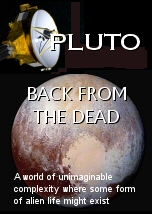
Pluto: Back From the Dead

   2020    Science
The incredible story of how Pluto has been propelled from an unremarkable ball of ice on the edge of the solar system to a world of unimaginable complexity - where some form of alien life might exist.
New discoveries from the edge of the solar system are transforming what is known about Pluto, thanks to the New Horizons space probe that took the first-ever close up images of the planet. Pluto was once thought to be geologically dead, but the pictures revealed it to be an active world of stunning complexity, with mountains carved from ice, a nitrogen glacier that appeared to be moving and a recently active volcano, with data sent back lead some scientists to speculate that there may even be life on Pluto today.
Series: Space Deepest Secrets

Once Brothers

   2010    Culture
Drazen Petrovic and Vlade Divac were two friends who grew up together sharing the common bond of basketball. Together, they lifted the Yugoslavian National team to unimaginable heights. After conquering Europe, they both went to America where they became the first two foreign players to attain NBA stardom. But with the fall of the Soviet Union on Christmas Day 1991, Yugoslavia split up. A war broke out between Petrovic's Croatia and Divac's Serbia. Long buried ethnic tensions surfaced. And these two men, once brothers, were now on opposite sides of a deadly civil war. As Petrovic and Divac continued to face each other on the basketball courts of the NBA, no words passed between the two. Then, on the fateful night of June 7, 1993, Drazen Petrovic was killed in an auto accident. "Once Brothers" will tell the gripping tale of these two men, how circumstances beyond their control tore apart their friendship, and whether Divac has ever come to terms with the death of a friend before they had a chance to reconcile.

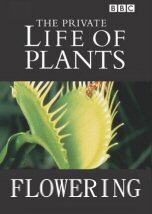
Flowering

   1995    Nature
The third episode is devoted to the ways in which plants reproduce. Pollen and a stigma are the two components needed for fertilisation. Most plants carry both these within their flowers and rely on animals to transport the pollen from one to the stigma of another. To do this, they attract their couriers with colour, scent and nectar. It isn't just birds that help pollination: some mammals and reptiles also do so. However, it is mostly insects that are recruited to carry out the task. To ensure that pollen is not wasted by being delivered to the wrong flower, some species of plant have developed exclusive relationships with their visitors, and the gentian and its attendant carpenter bees is one example. Since pollen can be expensive to produce in terms of calories, some plants, such as orchids, ration it by means of pollinia and a strategically placed landing platform. Other orchids offer no reward for pollination, but instead mislead their guests by mimicking their markings and aroma, thus enticing males to 'mate' with them (Pseudocopulation). The most extreme fertilisation method is one of imprisonment, and one plant that uses it is the dead horse arum. It is often found near gull colonies, and mimics the appearance and smell of rotting flesh. Blow-flies are attracted to it, and are forced to stay the night before being allowed to depart in the morning, laden with pollen. Finally, Attenborough introduces the world's largest inflorescence: that of the titan arum.
Series: The Private Life of Plants
Knights

Knights

2015  History
Leaving Neverland

Leaving Neverland

2019  Culture
Clarkson Farm

Clarkson Farm

2021  Nature
Chimp Empire

Chimp Empire

2023  Nature
Vikings Season 2

Vikings Season 2

2014  History
Earth from Space

Earth from Space

2019  Nature
Evolution

Evolution

2026  Science