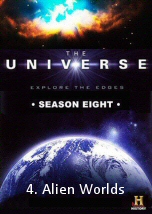
We are the generation of human beings that are going to know whether or not we're alone in the universe. This episode explores the search of exoplanets, from ancient Greek philosophers to the discoveries made possible with the Kepler Telescope. Unbelievable new worlds, planets made of diamond, planets of raining glass, worlds in collision, some plunging into stars, and others that just might harbor life. Thanks to today's planet hunters, our views of the universe and of our place in it are undergoing one of the greatest revolutions in scientific history.
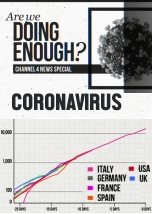
The Coronavirus disease 2019 (COVID-19) has spread globally since 2019, resulting in a pandemic. While the majority of cases result in mild symptoms, some progress to pneumonia and multi-organ failure. The deaths per number of diagnosed cases is estimated at between 1% and 5% but varies by age and other health conditions. In this special on the coronavirus, we're with health staff working on the front-line of the Covid-19 crisis - as well as the scientists, economists and virology experts who can answer the question... Coronavirus: Are We Doing Enough?
Two and a half thousand years ago, the Greek philosopher Socrates worried that the wide use of writing would have a negative impact on people's minds. He said that writing would create forgetfulness, because people will not use their memories. They would trust the external written characters and not remember themselves. In a world with an ever-growing tech industry, Michael Stevens tries to find out what effect technology has on our brains. He finds Technology isn't just changing our lives, it's changing our brains. In his experiments he tests what just 10 days of gaming does to things like our spatial memory.
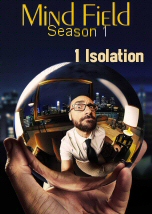
Your brain is like a hungry sponge. It's constantly absorbing information. It thrives when stimulated. Between smartphones and books, and movies, and friends and family, thousands of sensations are constantly going into our heads. But what if it all got cut off?. Imagine being confined to a 10-by-10-foot room in complete isolation. No timekeeping devices, no phones, no books, nothing to write on, no windows. Psychologists say that fewer than three days in a room like this can lead to brain damage. I will be staying in this room for three days. Michael explores the effects of isolation on the human mind by subjecting himself to a very interesting experiment.
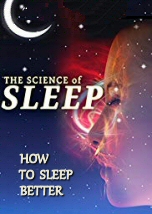
Gaby Roslin and Amir Khan present a program in which they apply the latest science to some of the worst sleepers. They include an extreme snorer, a man who suffers from night terrors, a woman who has restless leg syndrome, and a man with chronic insomnia for 20 years. The film also shows a sleep deprivation experiment to test for risky behaviour, pain resistance and emotional control. When the subjects reach the final hours of the challenge, the experiment begins to take its toll as the participants' emotions go into overdrive, with one threatening to quit altogether.
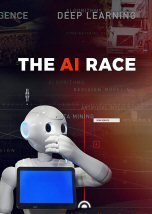
Explore how Artificial Intelligence will change your job as new research shows how much of what you do could be done by robots. From truckers to lawyers & doctors, we bring affected workers face to face with AI experts. How can we prepare for the coming changes to the world economy? We are on the precipice of another technological transformation. The last industrial revolution turned society upside down. It ultimately delivered greater prosperity and many more jobs, as well as the eight hour day and weekends.
But the transition was at times shocking and violent. The question is, can we do better this time? We don't realize that the future is not inevitable. The future is the result of the decisions we make today. These technologies are morally neutral, they can be used for good or for bad.
There's immense good things they can do, they can eliminate many disease,
they can help eliminate poverty, they can tackle climate change. Equally, the technology can be used for lots of bad. It can be used to increase inequality,it can be used to transform warfare. It can be used to make our lives much worse. We get to make those choices.










Thanks to today's planet hunters, our views of the universe and of our place in it are undergoing one of the greatest revolutions in scientific history.