






Last Watched

"Asia"  Sort by

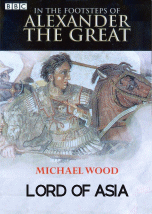
Lord of Asia

   1997    History
Michael crosses Iran towards the Caspian Sea. He meets nomads who tell of Alexander's tryst with an Amazon queen, and the living descendants of Alexander's Persian enemies, who have their own tales of `Alexander the Accursed'.
Series: In the Footsteps of Alexander the Great
Meat-Eaters

   1998    Nature
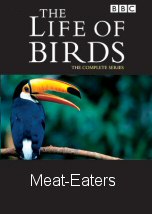
This episode examines those birds whose sustenance comes from flesh and their methods of hunting. In New Zealand, Sir Attenborough observes Keas, parrots that do not eat meat exclusively, raiding a shearwater's burrow for a chick. However, it is the dedicated birds of prey, such as owls, buzzards, eagles, falcons and vultures, to which much of the programme is devoted. In order to spot and pursue their victims, senses of sight and hearing are very acute. Vultures are the exception, in that they eat what others have left, and once a carcass is found, so many birds descend on it that the carrion seems submerged beneath them. The Turkey Vulture is an anomaly within its group, as it also has a keen sense of smell. Eagles defend their territory vigorously, and a pair of sea eagles are shown engaging in an aerial battle. The Galápagos Hawk hunts Marine Iguanas, but can only do so when its quarry is vulnerable, during the breeding season. The African Harrier Hawk has adapted to extracting burrowing animals by virtue of an especially long, double-jointed pair of legs. By contrast, a shrike is not equipped with the requisite sharp beak and talons needed for butchery, and so dismembers its kill by impaling it on the thorns of acacias. The Lammergeier eats bones, and will drop them on to rocks from a great height in order to break them down to a digestible size. Also featured are the Eurasian Sparrowhawk, Goshawk and Peregrine Falcon.
Series: The Life of Birds

Silk Roads and China Ships

   2016    History
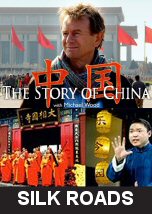
Michael Wood tells the tale of China's first great international age under the Tang Dynasty (618-907). From the picturesque old city of Luoyang, he travels along the Silk Road to the bazaars of central Asia and into India on the track of the Chinese monk who brought Buddhism back to China. This tale is still loved by the Chinese today and is brought to life by storytellers, films and shadow puppet plays. Then in the backstreets and markets of Xi'an, Michael meets descendants of the traders from central Asia and Persia who came into China on the Silk Road. He talks to Chinese Muslims in the Great Mosque and across town hears the amazing story of the first reception of Christianity in 635. Moving south, Michael sees the beginnings of China as an economic giant. On the Grand Canal, a lock built in 605 still handles 800 barges every day! The film tracks the rise of the silk industry and the world's favourite drink - tea. Michael looks too at the spread of Chinese script, language and culture across east Asia. 'China's influence on the East was as profound as Rome on the Latin West', he says, 'and still is today'. Finally, the film tells the intense drama of the fall of the Tang. Among the eyewitnesses were China's greatest poets. In a secondary school in a dusty village, where the Chinese Shakespeare - Du Fu - is buried in the grounds, the pupils take Michael through one famous poem about loss and longing as the dynasty falls. And in that ordinary classroom, there is a sense of the amazing drama and the deep-rooted continuities of Chinese culture.
Series: The Story of China

The Buddha

   2010    History
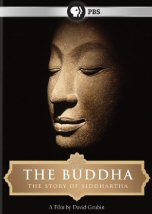
After 400 BC, a new philosophy was born in South east Asia, generated from the ideas of Buddha, a mysterious Prince from India who gained enlightenment while he sat under a large, shapely fig tree. He remains one of the most legendary and influential of all religious progenitors, but what of his actual life? In this biographical documentary, director David Grubin tells the historical tale of Gautama Buddha (563-483 BC), from his initial enlightenment through his death around the age of 80. In the process, Grubin makes an unusual point: that Gautama never once claimed to be God or God's emissary, but instead sought to find a way to bring peace and alleviation from suffering to others in a cruel and often insane world. In telling this story, Grubin combines a number of elements including original animations, testimony by contemporary Buddhists such as the 14th Dalai Lama Tenzin Gyatso, glimpses of sculptures and paintings that help tell Gautama's story, and much more. Narrated by Richard Gere

Protestantism The Evangelical Explosion

   2011    Culture
Diarmaid MacCulloch traces the growth of an exuberant expression of faith that has spread across the globe - Evangelical Protestantism. Today, it is associated with conservative politics, but the whole story is distinctly more unexpected. It is easily forgotten that the evangelical explosion has been driven by a concern for social justice and the claim that one could stand in a direct emotional relationship with God. It allowed the Protestant faith to burst its boundaries from its homeland in Europe. In America, its preachers marketed Christianity with all the flair and swashbuckling enterprise of American commerce. In Africa, it converted much of the continent by adapting to local traditions, and now it is expanding into Asia. But is Korean Pentecostalism and its message of prosperity in the here and now an adaptation too far?
Series: A History of Christianity
The Jinx Part 2

The Jinx Part 2

2024  History
Ancient Aliens

Ancient Aliens

  History
How Earth Made Us

How Earth Made Us

2010  Science
Dirty Money

Dirty Money

2018  Culture
Prehistoric Planet

Prehistoric Planet

2022  Science
The Germanic Tribes

The Germanic Tribes

2007  History