





Last Watched

"Australia"  Sort by

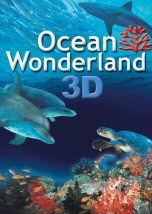
Ocean Wonderland 3D

   2003    Nature    3D    HD
The mission of the film is to underline the crucial ecological role of coral reefs play in maintaining the well being of our planet, and to point out and warn against the dangers that are destroying the world's coral reefs. Entirely filmed using digital technology, thanks to it, the film was shot almost entirely with natural light, thus showing the underwater world as it exactly is. This is the closest you can get to dive without being there. Shot on the Great Barrier Reef in Australia and in the Bahamas, it brings to you the amazing beauty of the many varieties of coral and the immense diversity of the marine life thriving there.

Patterned Planet

   2018    Nature    HD
Earth's surface is covered in weird and wonderful patterns. The Australian outback is covered in pale spots, the work of wombats; a clearing in the endless green canopy of the Congo rainforest has been created by an incredible elephant gathering; and the twists and turns of the Amazon make a home for rehabilitated manatees. This is our home, as we've never seen it before.
Series: Earth from Space

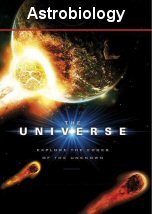
Astrobiology

   2008    Science
Does life exist on other planets? Astrobiology is a visionary new science that searches for life in space by combining the disciplines of astronomy, biology and geology. How did life evolve on Earth? What will life look like on other planets? These and other pertinent questions will be answered by a diverse group of scientists. Viewers will visit the Pilbara region of West Australia where the oldest evidence of life on Earth has been discovered. Travel to the moons of Jupiter and Saturn to test a theory that life could exist in the clouds of Venus. Finally, watch as experiments are done to see if life exists on exoplanets, earth-like planets beyond our solar system.
Series: The Universe

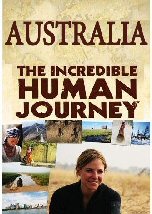
The Incredible Human Journey: Australia

   2009    History
Dr Alice Roberts looks at our ancestors' seemingly impossible journey to Australia. Miraculously preserved footprints and very old human fossils buried in the outback suggest a mystery: that humans reached Australia almost before anywhere else. How could they have travelled so far from Africa, crossing the open sea on the way, and do it thousands of years before they made it to Europe? The evidence trail is faint and difficult to pick up, but Alice takes on the challenge. In India, new discoveries among the debris of a super volcano hint that our species started the journey much earlier than previously thought, while in Malaysia, genetics points to an ancient trail still detectable in the DNA of tribes today. Alice travels deep into the Asian rainforests in search of the first cavemen of Borneo and tests out a Stone Age raft to see whether sea travel would have been possible thousands of years ago, before coming to a powerful conclusion.
Series: The Incredible Human Journey

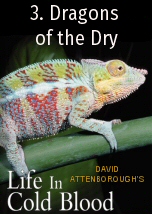
Dragons of the Dry

   2008    Nature
About 340 million years ago a brand new family of animals was evolving in the primeval swamps. They were to go one step further than the amphibians who had emerged onto dry and before them. For they would eventually completely cut their ties with water. They were the ancestors of todays lizards. They evolved scaly impermeable skins and moved up into the forests. They diversified into a multitude of different shapes and sizes. They developed signalling systems to communicate with one another. And they squabbled as animals do. For food they hunted insects that were already well established on the land in great numbers. And here without returning to water they produced their families. They powered their bodies not only with food but with the heat that they drew directly from the sun.
As they diversified so they spread into the harshest of the lands habitats. The baking waterless deserts which eventually they would come to dominate. Discover jacky lizards that wave, wrestling beaded lizards and the the world's smallest chameleon, which is no bigger than his thumbnail, and the biggest lizard in Australia.
Series: Life In Cold Blood

Frozen Planet: Spring

   2011    Nature
Spring arrives in the polar regions, and the sun appears after an absence of five months; warmth and life return to these magical ice worlds - the greatest seasonal transformation on our planet is underway. Male Adelie penguins arrive in Antarctica to build their nests - it takes a good property to attract the best mates and the males will stop at nothing to better their rivals! But these early birds face the fiercest storms on the planet. In the Arctic, a polar bear mother is hunting with her cubs. Inland, the frozen rivers start to break up and billions of tons of ice are swept downstream in the greatest of polar spectacles. This melt-water fertilizes the Arctic Ocean, feeding vast shoals of Arctic cod and narwhal. The influx of freshwater accelerates the breakup of the sea-ice - an area of ice the size of Australia will soon vanish from the Arctic. On land, a woolly bear caterpillar emerges from the snow having spent the winter frozen solid. Caterpillars normally become moths within months of hatching, but life is so harsh here that the woolly bear takes 14 years to reach adulthood. Once mature it has only days to find a mate before it dies! Alongside the caterpillars white Arctic wolves race to raise their adorable cubs before the cold returns.
Series: Frozen Planet