




Last Watched

"Explorer"  Sort by

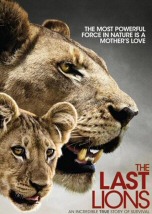
The Last Lions

   2011    Nature
Fifty years ago there were close to half-a-million lions in Africa. Today there are around 20,000. To make matters worse, lions, unlike elephants, which are far more numerous, have virtually no protection under government mandate or through international accords. This is the jumping-off point for a disturbing, well-researched and beautifully made cri de coeur from husband and wife team Dereck and Beverly Joubert, award-winning filmmakers from Botswana who have been Explorers-in-Residence at National Geographic for more than four years. Pointing to poaching as a primary threat while noting the lion's pride of place on the list for eco-tourists-an industry that brings in 200 billion dollars per year worldwide-the Jouberts build a solid case for both the moral duty we have to protect lions (as well as other threatened "big cats," tigers among them) and the economic sense such protection would make. And when one takes into account the fact that big cats are at the very top of the food chain-and that their elimination would wreak havoc on all species below them, causing a complete ecosystem collapse-the need takes on a supreme urgency.
Travellers Tales

   1980    Science
The journeys of the Voyager probes is put in the context of the Netherlands in the seventeenth century, with a centuries-long tradition of sailing ship explorers, and its contemporary thinkers (such as Constantijn Huygens and his son Christian). Their discoveries are compared to the Voyager probes' discoveries among the Jovian and Saturn systems. In Cosmos Update, image processing reconstructs Voyager’s worlds and Voyager’s last portrait of the Solar System as it leaves is shown.
Series: Cosmos

Deep Sea

   2006    Nature    3D    HD
An astonishing close encounter with some of the most exotic creatures inhabiting the hidden depths. In the realm of the giant octopus, the rainbow nudibranch (sea slug), and the Scorpion fish, viewers become a fearless undersea explorers, discovering the strange and unusual partnerships these 'star wars' creatures forge to ensure their survival, and learning how this cooperation allows life in this enchanting world to flourish. Filmmaker Howard Hall guides an astonishing adventure. Johnny Depp and Kate Winslet narrate as Green Sea Turtles gather so Surgeonfish can strip harmful algae from their shells. A Humboldt Squid changes color four times per second like a flashing strobe light. A Mantis Shrimp’s claws have the speed of a bullet in battling a hungry octopus. Brace yourself to be submerged in a wondrous new dimension.

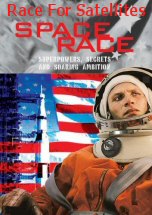
Race For Satellites

   2005    Technology
During 1953-1958, as the Cold War intensifies, Korolev is asked to build a rocket capable of carrying a five-ton warhead to America - he designs and constructs the R-7 Semyorka, and is later allowed to use it to launch the first satellite, Sputnik 1. Meanwhile, von Braun struggles to persuade the US government to allow him to launch his own satellite - after Sputnik's launch and the failure of the US Navy to launch a Vanguard satellite, he is finally allowed to launch the first American satellite, Explorer 1.
Series: Space Race

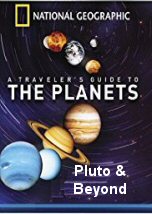
Pluto and Beyond

   2011    Science
Pluto is one of the Smaller than our own Moon, Pluto has never had a single visitor from Earth - until now. We keep saying, 'This is it, this is humanity's trip to Pluto. For the first time in human history, Pluto is about to be revealed. We can expect surprises, it's almost guaranteed. Until then, we can only guess what Pluto looks like. And recently, astronomers decided not to call it a planet any more. Once thought to be an isolated oddity, Pluto now marks the beginning of a whole new frontier. it's as if the explorers had climbed up to the top of the Rockies and were looking over and could see the lands of California on the other side. There has never been a better time to venture where no human has gone before. To follow in the footsteps of our robot pioneers and explore beyond the planets of our Solar System.
Series: A Traveler Guide to the Planets

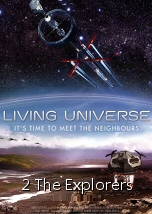
The Explorers

   2018    Technology
A look at the probes which explored our Solar System, laying the groundwork for a future spacecraft to search for life on a second Earth. That space craft must communicate, it must navigate, it must have power, it must have propulsion. We will have to give it all the intelligence necessary to make its own decisions. In 'The Explorers' the spacecraft Artemis initiates launch sequence and begins its 4.7 light year journey to Minerva B - an Earth-like exoplanet.
Series: Living Universe