









Last Watched

"Extinction"  Sort by

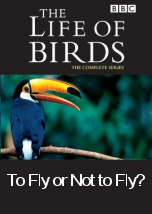
To Fly or Not to Fly

   1998    Nature
The first episode looks at how birds first took to the skies in the wake of the insects. It begins in Mexico, where Sir Attenborough observes bats being outmanoeuvred by a red-tailed hawk. Pterosaurs were the birds' forerunners, some 150 million years after dragonflies developed the means of flight, but eventually went extinct together with the dinosaurs. Birds had by then already evolved from early forms like archaeopteryx, the first creature to possess feathers. Its ancestry can be traced through reptiles, and some current species, such as the flying lizard, possibly show paths this evolution may have taken." One of the biggest birds to have ever existed was the terror bird, which proliferated after dinosaurs vanished and stood up to 2.5 metres tall. By comparison, the ostrich, while not closely related, is the largest and heaviest living bird. It was probably the evasion of predators that drove most birds into the air, so their flightless cousins evolved because they had few enemies. Accordingly, such species are more likely to be found on islands, and Sir Attenborough visits New Zealand to observe its great variety, most especially the kiwi. Also depicted is the moa, another huge creature that is now gone. The takahē is extremely rare, and high in the mountains of New Zealand, Sir Attenborough discovers one from a population of only 40 pairs. Finally, another example on the brink of extinction is the kakapo, which at one point numbered only 61 individuals. A male is heard calling — an immensely amplified deep note that can be heard at great distances from its nest.
Series: The Life of Birds
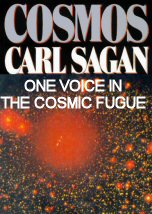
One Voice in the Cosmic Fugue

   1980    Science
Sagan discusses the story of the Heike crab and artificial selection of crabs resembling samurai warriors, as an opening into a larger discussion of evolution through natural selection (and the pitfalls of intelligent design). Among the topics are the development of life on the Cosmic Calendar and the Cambrian explosion; the function of DNA in growth; genetic replication, repairs, and mutation; the common biochemistry of terrestrial organisms; the creation of the molecules of life in the Miller-Urey experiment; and speculation on alien life (such as life in Jupiter's clouds). In the Cosmos Update ten years later, Sagan remarks on RNA also controlling chemical reactions and reproducing itself and the different roles of comets (potentially carrying organic molecules or causing the Cretaceous–Paleogene extinction event).
Series: Cosmos

Nemesis The Sun Evil Twin

   2011    Science
The theory of Némesis, a star that orbits the Sun and causes catastrophic events is explored. Nemesis is a hypothetical red dwarf or brown dwarf, originally postulated in 1984 to be orbiting the Sun at a distance of about 95,000 AU (1.5 light-years) somewhat beyond the Oort cloud, to explain a perceived cycle of mass extinctions in the geological record, which seem to occur more often at intervals of 26 million years.
Series: The Universe

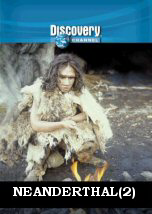
Neanderthal 2

       History
Long ago, two species of human beings coexisted on Earth until competition drove one of them to extinction. This program, set in the southwest of France 35,000 years ago, reconstructs the life in the Neanderthal world at the time Cro-Magnons first entered the scene. All aspects of Neanderthal clan life are examined, including tool- and weapon-making, hunting and gathering, health and healing, childbirth, rituals, and making fire. Footage of skeletal remains and the scholarly research of eminent paleontologist Chris Stringer and Oxford University's Paul Pettitt support the documentary.
Series: Neanderthal

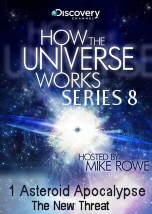
Asteroid Apocalypse: The New Threat

   2019    Science
How is the universe put together? How is it built? And how does it actually work? How the Universe Works Series 8 shows the inner workings of our planet, the solar system, the galaxies and the universe itself.
In the first episode, if a massive asteroid collides with earth, it could end life on our planet as we know it. New discoveries and cutting-edge tech reveal just how close we are to apocalypse and what it would take for the world's leading space agencies to stop it.
Series: How the Universe Works Series 8

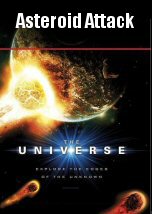
Asteroid Attack

   2010    Science
What are the latest discoveries in the deadly world of asteroids? Will a recently returned Japanese spacecraft become the first to bring an asteroid sample back to our planet? What would happen to America's East Coast if the massive asteroid impact that helped form Chesapeake Bay 35 million years ago struck today? And why did President Barack Obama choose an asteroid as the destination for the next great manned mission into space? Learning about these huge space rocks isn't just about science, it's about survival.
Series: The Universe
Human

Human

2025  History
Tiger

Tiger

2020  History
Alien Worlds

Alien Worlds

2020  Science
Wonders of Life

Wonders of Life

2013  Science
Mind Field

Mind Field

2019  Medicine
Frozen Planet

Frozen Planet

2011  Nature
Prehistoric Planet

Prehistoric Planet

2022  Science