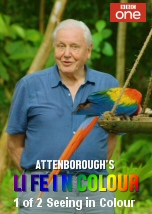
The natural world is full of colours. For us, they are a source of beauty, but for animals they are a tool for survival. David Attenborough reveals the extraordinary ways in which animals use colour: to win a mate, to fight off rivals and to warn enemies. New camera technologies - some developed especially for this series – also allow us to see colours and patterns usually invisible to human eyes. Ultraviolet cameras reveal bright signals on a butterfly’s wings and facial markings on yellow damselfish that are used as secret communication channels. Some animals can also detect polarized light, and specialist cameras can now show us how fiddler crabs see the world, and how mantis shrimp have strange polarization patterns on their bodies to signal to a mate or rival.
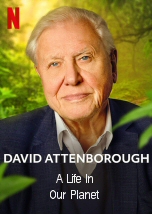
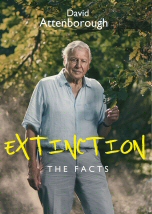
With a million species at risk of extinction, Sir David Attenborough explores how this crisis of biodiversity has consequences for us all, threatening food and water security, undermining our ability to control our climate and even putting us at greater risk of pandemic diseases. Everything in the natural world is connected in networks that support the whole of life on earth, and we are losing many of the benefits that nature provides to us. The loss of insects is threatening the pollination of crops, while the loss of biodiversity in the soil also threatens plants growth. Last year, a UN report identified the key drivers of biodiversity loss, including overfishing, climate change and pollution. But the single biggest driver of biodiversity loss is the destruction of natural habitats. Seventy-five per cent of Earth's land surface (where not covered by ice) has been changed by humans, much of it for agriculture, and as consumers we may unwittingly be contributing towards the loss of species through what we buy in the supermarket. Human activities like the trade in animals and the destruction of habitats drive the emergence of diseases. Disease ecologists believe that if we continue on this pathway, this year’s pandemic will not be a one-off event.
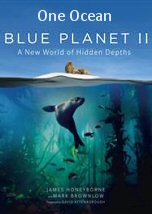
Nearly a generation after the acclaimed Blue Planet documentary was released, David Attenborough returns to narrate this groundbreaking sequel/reboot. Blue Planet II focuses more heavily on mankind's influence on the world's oceans through both global pollution and climate change. This series features a variety of revolutionary segments never before seen in a video documentary. One Ocean Footage of marine life in different environments around the north, beginning with a tropical coral reef which has medicinal properties for dolphins, and is used as a tool by tusk fish. In Japan, a shipwreck is home to the Asian sheepshead wrasse, which can change gender, while in the polar north, walruses struggle to find ice floes for their pups to rest on as climate change takes its toll on the environment.
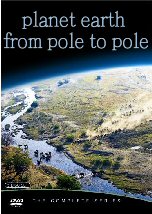
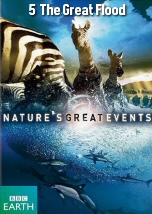
The great flood in the Okavango turns 4,000 square miles of arid plains into a beautiful wetland. Elephant mothers guide their families on an epic trek across the harsh Kalahari Desert towards it, siphoning fresh water from stagnant pools and facing hungry lions. Hippos battle for territory, as the magical water draws in thousands of buffalo and birds, and vast clouds of dragonflies. Will the young elephant calves survive to reach this grassland paradise? The experienced mother elephants time their arrival at the delta to coincide with the lush grass produced by the great flood. In a TV first, the programme shows the way they use their trunks to siphon clean water from the surface layers of a stagnant pool, while avoiding stirring up the muddy sediment on the bottom with their feet. Lechwe swamp deer, zebras, giraffes, crocodiles and numerous fish and thousands of birds arrive in the delta. And, in a phenomenon never before filmed in the Okavango, thousands of dragonflies appear - seemingly from nowhere - within minutes of the flood arrival, mating and laying eggs. As the flood finally reaches its peak, elephants and buffalo, near the end of their epic trek across the desert, face the final gauntlet of a hungry pride of lions. In a heart-wrenching sequence, a baby elephant is brought down by a lion in broad daylight.
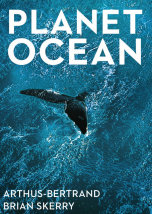
An elegantly filmed documentary, Planet Ocean takes us on a beautiful adventure into the strangest domains of our planet - the oceans. The film features both the magnificence and the exposure of Earth's oceans. The dangers that threaten the whole planet also threaten us. We are guided through various series of events (sailfish relying on mackerel; mackerel relying on zooplankton; zooplankton relying on marine prairie) it is not simply to demonstrate the function of a food chain, but to illustrate the way in which all life is intrinsically interconnected. What happens to our oceans happens to our selves.
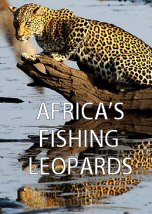
David Attenborough narrates the intimate story of a leopard mother and her two cubs. This very special family must survive in the wilds of Botswana alongside some less-than-friendly neighbours: lions, wild dogs and hyenas. The competition for food is tough, and if they are going to make it they must learn a new skill - they must learn to fish. This is an epic family drama. With them every step of the way is local cameraman Brad Bestelink. Brad's 18-month journey following the lives of these secretive big cats offers a rare glimpse into an otherwise hidden world.












Ultraviolet cameras reveal bright signals on a butterfly’s wings and facial markings on yellow damselfish that are used as secret communication channels. Some animals can also detect polarized light, and specialist cameras can now show us how fiddler crabs see the world, and how mantis shrimp have strange polarization patterns on their bodies to signal to a mate or rival.