





Last Watched

"Reef"  Sort by

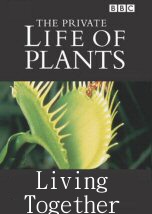
The Private Life of Plants Living Together

   1995    Nature
The fifth programme explores the alliances formed between the animal and plant worlds. Attenborough dives into Australia's Great Barrier Reef and contrasts the nocturnal feeding of coral, on microscopic creatures, with its daytime diet of algae. Some acacias are protected by ants, which will defend their refuge from any predator. Besides accommodation, the guards are rewarded with nectar and, from certain species, protein for their larvae as well. Fungi feed on plants but can also provide essential nutriment to saplings (Mycorrhiza). The connection is never broken throughout a tree's life and a quarter of the sugars and starches produced in its leaves is channelled back to its fungal partners. Meanwhile, fungi that feed on dead wood leave a hollow trunk, which also benefits the tree. Orchids enjoy a similar affiliation. Lichens are the product of a relationship between fungi and a photosynthetic associate, usually algae. They are extremely slow-growing, and a graveyard is the perfect location to discover their exact longevity. Mistletoe is a hemiparasite that obtains its moisture from a host tree, while using own leaves to manufacture food. Its seeds are deposited on another by the mistletoe tyrannulet, following digestion of the fruit. The dodder (Cuscuta) is also parasitic, generally favouring nettles, and siphons its nourishment through periodic 'plugs' along its stem. The rafflesia has no stem or leaves and only emerges from its host in order to bloom — and it produces the largest single flower: one metre across.
Series: The Private Life of Plants
The Deep

   2017    Naturaleza    HD
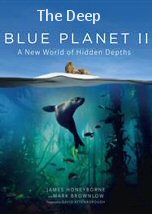
The deep is perhaps the most hostile environment on earth, at least to us - a world of crushing pressure, brutal cold and utter darkness. We have barely begun to explore it, and yet it is the largest living space on the planet. Scientists already think that there is more life in the deep than anywhere else on earth. This episode takes us on an epic journey into the unknown, a realm that feels almost like science fiction. We discover alien worlds, bizarre creatures and extraordinary new behaviours never seen before. We encounter savage hordes of Humboldt squid hunting lanternfish in the depths and coral gardens flourishing in absolute darkness, with more species of coral to be found in the deep than on shallow tropical reefs. Narrated by David Attenborough.
Series: Blue Planet II

Blue Planet II Coral Reefs

   2017    Nature
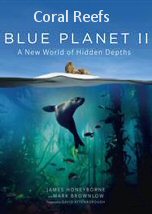
Corals build themselves homes of limestone in the warm, clear, shallow seas of the tropics. Their reefs occupy less than one tenth of one per cent of the ocean floor, yet they are home to a quarter of all known marine species. The broad-club cuttlefish has found its place by using a hypnotic display that apparently mesmerizes its prey, causing it to let down its defences. On the Great Barrier Reef a remarkable grouper uses sign language, dubbed the headstand signal, to reach out to an entirely different creature, a reef octopus, to flush small fish out of their hiding holes and into the groupers waiting mouth.
Series: Blue Planet II

Green Seas

   2017    Nature
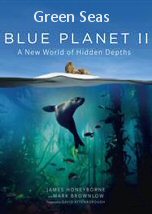
This episode includes footage of wildlife inhabiting underwater kelp forests, thousands of giant cuttlefish spawning along a restricted area of rocky reef off the south coast of Australia. Males outnumber females 11 to one, which leads to fierce competition. Larger males use brute force to drive off competition, while their smaller rivals use deception by mimicking the appearance of females. The programme also features tiger sharks hunting for green turtles in fields of seagrass and spider crabs trying to avoid predators while they shed their shells.
Series: Blue Planet II

Hiding in Colour

   2021    Nature
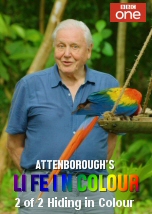
David Attenborough reveals the extraordinary ways that some animals use colour to hide and disappear into the background. New science reveals how the Bengal tiger in central India uses its orange-black stripes to hide from its colour-blind prey. In Kenya’s Masai Mara, the zebra’s black-and-white pattern confuses predators with an extraordinary effect called motion dazzle. And on the island of Cuba, a small snail uses colourful stripes in a surprising way to hide from its enemies.
Other animals use colour to trick and to deceive. On Australia’s Great Barrier Reef, a blue-striped blenny uses colours to mimic other fish and launch a sudden attack. In the grasslands of Zambia, the chick of a pin-tailed whydah mimics the patterns of its nest mates to ensure that it is not detected as an imposter. And specialist cameras reveal how a tiny crab spider uses bright ultraviolet colours to lure in its victims.
Series: Attenborough Life in Colour

Fasting

   2022    Medicine
Chris turns to longevity doctor Peter Attia to find out how changing his eating habits can help his quest for longevity. Ironically, the answer is to eat no food at all for four long days. If he can bear the hunger, fasting will unlock his body’s own anti-aging powers and give Chris the edge he needs when he tries to hunt for his next meal … by spearfishing off the Great Barrier Reef.
Series: Limitless with Chris Hemsworth
Leaving Neverland

Leaving Neverland

2019  Culture
Sonic Highways

Sonic Highways

2014  Art
Planet Earth

Planet Earth

2007  Nature
Most Wanted: Teen Hacker

Most Wanted: Teen Hacker

2025  Technology
The Sky at Night

The Sky at Night

2025  Science
The Truth About

The Truth About

2018  Medicine