
Last Watched

"Skin"  Sort by

Colours of Life

   2015    Science
Earth is the most colourful place we know of. But the colours we see are far more complex and fascinating than they appear. In this series, Dr Helen Czerski uncovers what colour is, how it works, and how it has written the story of our planet - from the colours that transformed a dull ball of rock into a vivid jewel to the colours that life has used to survive and thrive". But the story doesn't end there - there are also the colours that we can't see, the ones that lie beyond the rainbow. Each one has a fascinating story to tell. Early Earth was a canvas for the vast new palette of the colours of life, with the diversity of human skin tones telling the story of how humanity spread and ultimately conquered the planet. Dr Helen Czerski explores the true masters of colour - which are often the smallest and most elusive - travelling to the mountains of Tennessee to witness the colourful mating display of fireflies, and revealing the marine creatures that can change the colour of their skin in order to hide from the world.
Series: Colour The Spectrum of Science
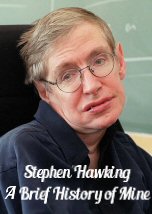
Stephen Hawking: A Brief History of Mine

   2013    History
This new feature-length biographical film tells the extraordinary and dramatic story of the planet's most famous living scientist, told for the first time in his own words and by those closest to him. Made with unique access to his private life, this is an intimate and moving journey into Stephen Hawking's past and present. Interviewees include Stephen Hawking's sister Mary, his ex-wife Jane, carers and students, as well as colleagues such as Roger Penrose, plus Apollo astronaut Buzz Aldrin, actors Benedict Cumberbatch and Jim Carrey, and Sir Richard Branson This inspirational portrait of an iconic figure relates Hawking's incredible personal journey from boyhood underachiever to scientific genius and multi-million-selling author. And it charts how he overcame being diagnosed with motor neurone disease - and being given just two years to live - to make amazing scientific discoveries and become a symbol of triumph over adversity. Born exactly 300 years after the death of Galileo, Hawking grew up in a family some regarded as eccentric. Always asking questions, he was nicknamed 'Einstein' at school. Hawking blossomed at Oxford, although he only spent an hour a day studying. He noticed that he was becoming clumsy and fell over for no apparent reason. He was diagnosed with motor neurone disease, but nevertheless started a family and embarked on his academic career, finding himself at the heart of a searing scientific debate about the origins of the universe. And as he lost the use of his body, Hawking had to find new ways to think. He went on to write the huge bestseller A Brief History of Time, and the film reveals the high and lows of his resulting fame and fortune.

Science Britannica: Frankenstein Monsters

   2013    Culture
Professor Brian Cox grapples with science's darker side, asking why, when science has done so much for us, it often gets such a bad press. Starting with the original Frankenstein - the grisly 19th century tale of George Foster's hanging and subsequent 'electrocution', Brian confronts the idea that science can go 'too far'. From the nuclear bomb to genetic modification, British science has always been at the cutting edge of discovery, but are British scientists feckless meddlers, or misunderstood visionaries whose gifts to humanity are corrupted by the unscrupulous?

Do You Know What Time It Is

   2008    Science
Particle physicist Prof. Brian Cox asks, 'What time is it?' It's a simple question and it sounds like it has a simple answer. But do we really know what it is that we're asking? Brian visits the ancient Mayan pyramids in Mexico where the Maya built temples to time. He finds out that a day is never 24 hours and meets Earth's very own Director of Time. He journeys to the beginning of time, and goes beyond within the realms of string theory, and explores the very limit of time. He discovers that we not only travel through time at the speed of light, but the experience we feel as the passing of time could be an illusion.

Factories of Death

   2005    History
ln 1942 through an horrific process of trial and error these Nazis created something entirely new in History - killing factories capable of murdering millions. With the increase in killing at Auschwitz and nearby Treblinka, people are showing tremendous courage, like German officer Albert Battel risking his life to save detainees.
Series: Auschwitz The Nazis and the Final Solution

Cosmic Phenomena

   2009    Nature
A variety of cosmic events have both helpful and harmful effects on life on Earth. From the beauty of the Aurora Borealis and rainbows to the dangers of UV radiation and cosmic rays, from the miracle of photosynthesis to the thrill of a meteor shower, this episode explores how the effects generated by the sun and other extra-solar sources can literally get under our skin, scramble our technology, make life possible and threaten our existence all at the same time
Series: The Universe
Chased by Sea Monsters

Chased by Sea Monsters

2003  Science
Planet Earth III

Planet Earth III

2023  Nature
Life in the Undergrowth

Life in the Undergrowth

2005  Nature
Space Race

Space Race

2005  Technology
The Crime of the Century

The Crime of the Century

2021  Medicine
Wild Wild Country

Wild Wild Country

2018  Culture
The Virtual Revolution

The Virtual Revolution

2010  Technology