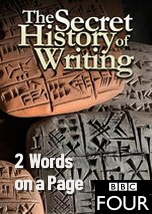
Writing itself is 5,000 years old, and for most of that time words were written by hand using a variety of tools. The Romans were able to run an empire thanks to documents written on papyrus. Scroll books could be made quite cheaply and, as a result, ancient Rome had a thriving written culture. With the fall of the Roman Empire, papyrus became more difficult to obtain. Europeans were forced to turn to a much more expensive surface on which to write: Parchment. Medieval handwritten books could cost as much as a house, they also represent a limitation on literacy and scholarship. No such limitations were felt in China, where paper had been invented in the second century. Paper was the foundation of Chinese culture and power, and for centuries how to make it was kept secret. When the secret was out, paper mills soon sprang up across central Asia. The result was an intellectual flourishing known as the Islamic Golden Age. Muslim scholars made discoveries in biology, geology, astronomy and mathematics. By contrast, Europe was an intellectual backwater. That changed with Gutenberg’s development of movable type printing. The letters of the Latin alphabet have very simple block-like shapes, which made it relatively simple to turn them into type pieces. When printers tried to use movable type to print Arabic texts, they found themselves hampered by the cursive nature of Arabic writing. The success of movable type printing in Europe led to a thousand-fold increase in the availability of information, which produced an explosion of ideas that led directly to the European Scientific Revolution and the Industrial Revolution that followed.
The 1980s was a time when artists in both the UK and US were delivering powerful social commentary in their songs. Dylan Jones selects some of the finest alternative voices from this era. From The Cure on Top of the Pops at the beginning of the decade to The Stone Roses' debut TV performance in 1989, this episode takes a comprehensive look at the alternative music of an entire era. It also features powerful live performances from Billy Bragg, Tracy Chapman, Bronski Beat and The Selecter. In addition, there are archival gems from Pixies, The Smiths, Suzanne Vega, The Fall, REM and many more.
Jennifer Griffith and Sarah Carver were working for the Disability Administration and noticed all this corruption firsthand. They wrote to the Social Security Administration, wrote to lawyers, wrote to the president of the United States. But nothing ever came of their complaints until the Wall Street Journal story broke. Then, with national attention brought to Conn, the Senate, the FBI and the SSA (who’d been enabling the fraud the whole time) finally stepped in. Series finale. Eric leads the government on a wild goose chase. The fallout from the fraud takes its toll on a struggling Kentucky community.
Sir David Attenborough explores the incredible diversity of Britain’s woodlands, taking us on a seasonal journey through our forests, and revealing a host of spectacular animals and the hidden dramas that rule their lives. In an ancient pine tree in the Cairngorms, two eagle chicks are on the verge of fledging their gargantuan nest. In winter in the Forest of Dean, the reintroduction of wild boar has given the robin a lifeline. As they root through the thick snow, the boar unearth the worms with their snouts, which the robins otherwise couldn't find. Back in Scotland, a male capercaillie displays to gathering females. These birds are on the edge. With only around 500 left, they are some of the rarest and most threatened in the British Isles. In a beech woodland outside London, the deciduous trees burst to life in spring, and huge colonies of wood ants awaken and go looking for food. Also looking for sustenance is a female roe deer. With no large predators left in our woods, the deer are free to browse on new growth to the extent that they can damage the woodland itself. In Sussex is an ancient-looking landscape, but one that has only been recreated in the past 20 years. This is the wood pasture of Knepp, created by using old grazing methods that generate a mix of scrub, open areas and ancient trees. In the Scottish Highlands, red squirrels battle it out for access to ripe pine cones at the top of a tree. It’s an acrobatic and energetic encounter, with more than a little cunning required to win the day. As the summer finally fades, we encounter a honey buzzard nest, where two chicks feast on wasp grubs, squabble between themselves and grow up before our eyes. Autumn brings the fallow deer rut. The woods resonate with their calls, and bucks fight for supremacy. The season also brings colour, both in the leaves but also in the fungi that fruit at this time of year. The mushrooms are just a tiny part of their story, however, and we travel underground to see how the wood-wide web connects the whole forest together.
This gripping five-part docuseries marks the 50th anniversary of the fall of Saigon, revealing how a distant war redefined two nations. With unseen footage, candid interviews, and damning presidential recordings, it exposes the political manipulation, battlefield tragedies, and societal fractures that shaped the Vietnam War. From Washington’s strategic missteps to the raw trauma of those on the ground, it shows how the conflict shattered trust in government and left wounds that still resonate today. The first three episodes trace the war’s slow ignition and its rapid spiral into chaos. They take viewers deep into the secretive early stages of the U.S. military buildup, then shift to the complex realities inside Vietnam, with personal accounts from soldiers on both sides. The series then confronts the shock of the Tet Offensive and the atrocities of Mỹ Lai, dismantling the illusion of a winnable war. These opening chapters set a powerful tone—intimate, harrowing, and unflinchingly honest.








No such limitations were felt in China, where paper had been invented in the second century. Paper was the foundation of Chinese culture and power, and for centuries how to make it was kept secret. When the secret was out, paper mills soon sprang up across central Asia. The result was an intellectual flourishing known as the Islamic Golden Age. Muslim scholars made discoveries in biology, geology, astronomy and mathematics. By contrast, Europe was an intellectual backwater.
That changed with Gutenberg’s development of movable type printing. The letters of the Latin alphabet have very simple block-like shapes, which made it relatively simple to turn them into type pieces. When printers tried to use movable type to print Arabic texts, they found themselves hampered by the cursive nature of Arabic writing. The success of movable type printing in Europe led to a thousand-fold increase in the availability of information, which produced an explosion of ideas that led directly to the European Scientific Revolution and the Industrial Revolution that followed.