The incredible story of how Pluto has been propelled from an unremarkable ball of ice on the edge of the solar system to a world of unimaginable complexity - where some form of alien life might exist. New discoveries from the edge of the solar system are transforming what is known about Pluto, thanks to the New Horizons space probe that took the first-ever close up images of the planet. Pluto was once thought to be geologically dead, but the pictures revealed it to be an active world of stunning complexity, with mountains carved from ice, a nitrogen glacier that appeared to be moving and a recently active volcano, with data sent back lead some scientists to speculate that there may even be life on Pluto today.
Dr Alice Roberts looks at our ancestors' seemingly impossible journey to Australia. Miraculously preserved footprints and very old human fossils buried in the outback suggest a mystery: that humans reached Australia almost before anywhere else. How could they have travelled so far from Africa, crossing the open sea on the way, and do it thousands of years before they made it to Europe? The evidence trail is faint and difficult to pick up, but Alice takes on the challenge. In India, new discoveries among the debris of a super volcano hint that our species started the journey much earlier than previously thought, while in Malaysia, genetics points to an ancient trail still detectable in the DNA of tribes today.
Alice travels deep into the Asian rainforests in search of the first cavemen of Borneo and tests out a Stone Age raft to see whether sea travel would have been possible thousands of years ago, before coming to a powerful conclusion.
SETTING: 72 million years ago, near present-day Montana. As a young male daspletosaurus, it's Das' job to herd unsuspecting prey towards the rest of the pack. But he's easily distracted and ruins several hunts getting him in deep trouble with his mother, the pack leader. When a volcano threatens, the dinosaurs are unprepared.
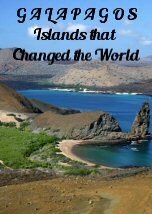
From flightless cormorants hunting underwater to giant tortoises courting on the rim of an active volcano, a look at the hidden side of Galapagos, revealing why it is such a fascinating showcase for evolution.
Earth may seem like the most hospitable planet in the solar system. But look again. Startling new discoveries reveal the blue planet has been plagued by more chaos and destruction than scientists once imagined. Stand on the Earth billions of years ago as a primitive planet called Theia slams into it. Shiver as our entire globe is frozen over like a gigantic snowball. Feel the heat as mammoth volcanoes scorch the landscape and darken the sky. From a cosmic gamma ray burst frying away the ozone layer to an Everest-size asteroid slamming into the ocean, we'll reveal new information about how these unparalleled events drove life to the brink of total extinction. Out of this continuous devastation, how has our planet--and life--got to where it is today? Are the worst days behind us--or lurking in the distant future?
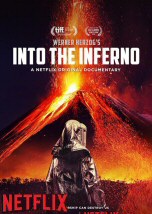
An exploration of active volcanoes in Indonesia, Iceland, North Korea and Ethiopia, Herzog follows volcanologist and co-director Clive Oppenheimer, who hopes to minimize the volcanoes’ destructive impact. What is the Herzog’s quest? To gain an image of our origins and nature as a species. He finds that the volcano—mysterious, violent, and rapturously beautiful—instructs us that, "there is no single one that is not connected to a belief system".
















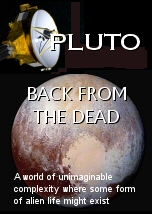








New discoveries from the edge of the solar system are transforming what is known about Pluto, thanks to the New Horizons space probe that took the first-ever close up images of the planet. Pluto was once thought to be geologically dead, but the pictures revealed it to be an active world of stunning complexity, with mountains carved from ice, a nitrogen glacier that appeared to be moving and a recently active volcano, with data sent back lead some scientists to speculate that there may even be life on Pluto today.