


Last Watched

"Writing"  Sort by

The Immortals

   2014    Science
This episode covers the nature of how life may have developed on Earth and the possibility of life on other planets. Tyson begins by explaining how the human development of writing systems enabled the transfer of information through generations, describing how Princess Enheduanna ca. 2280 BCE would be one of the first to sign her name to her works, and how Gilgamesh collected stories, including that of Utnapishtim documenting a great flood comparable to the story of Noah's Ark. Tyson explains how DNA similarly records information to propagate life, and postulates theories of how DNA originated on Earth, including evolution from a shallow tide pool, or from the ejecta of meteor collisions from other planets. In the latter case, Tyson explains how comparing the composition of the Nakhla meteorite in 1911 to results collected by the Viking program demonstrated that material from Mars could transit to Earth, and the ability of some microbes to survive the harsh conditions of space. With the motions of solar systems through the galaxy over billions of years, life could conceivably propagate from planet to planet in the same manner. Tyson then moves on to consider if life on other planets could exist. He explains how Project Diana performed in the 1960s showed that radio waves are able to travel in space, and that all of humanity's broadcast signals continue to radiate into space from our planet. Tyson notes that projects have since looked for similar signals potentially emanating from other solar systems. Tyson then explains that the development and lifespan of extraterrestrial civilizations must be considered for such detection to be realized. He notes that civilizations can be wiped out by cosmic events like supernovae, natural disasters such as the Toba disaster, or even self-destruct through war or other means, making probability estimates difficult. Tyson describes how elliptical galaxies, in which some of the oldest red dwarf stars exist, would offer the best chance of finding established civilizations. Tyson concludes that human intelligence properly applied should allow our species to avoid such disasters and enable us to migrate beyond the Earth before the Sun's eventual transformation into a red giant.
Series: Cosmos: A Spacetime Odyssey
Tesla: Master of Lightning

   2007    History
The story of Nikola Tesla, the great scientist, visionary, and inventor who gave the world alternating current electricity, as well as being the father of radio. The film tells the story of this man's astonishing genius, his visions and inventions. Tesla's own scientific and autobiographical writings, as well as archival photographs and re-enactments are used to tell the story. A native of Austro-Hungary, Tesla came to America in 1884. Working first with Edison, the two inventors fell out over Edison's insistence on using direct current. Tesla took his alternating current vision to Westinghouse. Tesla worked to unlock the secrets of energy and electricity. The film follows Tesla's exploits and eccentricities, which made him a darling of the press. Largely forgotten today in spite of the great debt the modern world owes him, the film pays tribute to this overlooked genius

Woody Allen A Documentary 2

   2011    History
The film chronicles Allen's career - from teen writer to Sid Caesar's TV scribe, from stand-up comedian to award-winning writer-director averaging one film-per-year for more than 40 years. Exploring Allen's writing habits, casting, directing, and relationship with his actors first-hand, new interviews with A-listers, writing partners, family and friends provide insight and backstory to the usually inscrutable filmmaker.
Series: Woody Allen A Documentary

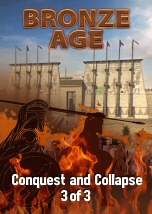
Conquest and Collapse

   2016    History
The Bronze Age had the first large urban centers, powerful kingdoms and armies, writing, and trade routes across vast areas. What led to the collapse of the city-state entities and the end of the Bronze Age? Possibly a perfect storm of uncontrollable factors that are still being researched.
Series: Bronze Age

Words on a Page

   2020    History
Writing itself is 5,000 years old, and for most of that time words were written by hand using a variety of tools. The Romans were able to run an empire thanks to documents written on papyrus. Scroll books could be made quite cheaply and, as a result, ancient Rome had a thriving written culture. With the fall of the Roman Empire, papyrus became more difficult to obtain. Europeans were forced to turn to a much more expensive surface on which to write: Parchment. Medieval handwritten books could cost as much as a house, they also represent a limitation on literacy and scholarship.
No such limitations were felt in China, where paper had been invented in the second century. Paper was the foundation of Chinese culture and power, and for centuries how to make it was kept secret. When the secret was out, paper mills soon sprang up across central Asia. The result was an intellectual flourishing known as the Islamic Golden Age. Muslim scholars made discoveries in biology, geology, astronomy and mathematics. By contrast, Europe was an intellectual backwater.
That changed with Gutenberg’s development of movable type printing. The letters of the Latin alphabet have very simple block-like shapes, which made it relatively simple to turn them into type pieces. When printers tried to use movable type to print Arabic texts, they found themselves hampered by the cursive nature of Arabic writing. The success of movable type printing in Europe led to a thousand-fold increase in the availability of information, which produced an explosion of ideas that led directly to the European Scientific Revolution and the Industrial Revolution that followed.
Series: The Secret History of Writing

Changing the Script

   2020    History
The written word is so important in everyday life that there can be few more radical acts than forcing an entire nation to learn a new script. Yet that is what happened in Turkey in 1928 when Mustafa Kemal decreed that the Arabic script would be replaced by the letters of the Latin alphabet. Communication with computers using human language is usually made with Latin letters. This is how most Chinese people interact with their computers and smart phones, using a Latin-based phonetic script called Pinyin. As a result, even highly educated Chinese are losing the ability to write using Chinese characters. Could what is happening in China be the future of writing everywhere?
Series: The Secret History of Writing
Human

Human

2025  History
Prehistoric Planet

Prehistoric Planet

2022  Science
The Jinx

The Jinx

2015  History
Strangest Things

Strangest Things

2021  History
Atom

Atom

2007  Science
The Crime of the Century

The Crime of the Century

2021  Medicine
The Sky at Night

The Sky at Night

2015  Culture