








Last Watched

"atmosphere"  Sort by

Colonizing Space

   2008    Technology
Space colonization is no longer the fodder of science fiction, it is becoming a reality. Examine the efforts underway to establish a human colony on Mars, including how they plan to grow food, recycle wastewater and introduce greenhouse gases to revive the red planet and make it more habitable for humans. Cutting-edge computer graphics are used to bring the universe down to earth to show what life would be like on Mars, and to imagine what kind of life forms might evolve in alien atmospheres.
Series: The Universe
Wind

   2010    Science
Iain sets sail on one of the fastest racing boats ever built to explore the story of our turbulent relationship with the wind. Travelling to iconic locations including the Sahara desert, the coast of West Africa and the South Pacific, Iain discovers how people have exploited the power of the wind for thousands of years. The wind is a force which at first sight appears chaotic. But the patterns that lie within the atmosphere have shaped the destiny of continents, and lie at the heart of some of the greatest turning points in human history.
Series: How Earth Made Us

Storm Worlds

   2024    Science    3D    HD
In Episode 3, embark on a breathtaking journey with Professor Brian Cox as he ventures into the storm worlds of our solar system. This chapter uncovers colossal tempests that have raged for centuries, metallic frost blanketing alien mountains, and monsoon rains falling a billion kilometers from Earth. A visually stunning exploration of the most extreme weather in the cosmos — a chapter that will forever change how we view planetary atmospheres.
Series: Solar System

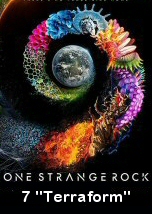
Terraform

   2018    Science
We sure lucked out with Planet Earth. Blue skies, rolling hills, water everywhere. But our home didn't come like this out of the box. Earth was a real fixer-upper, and it took some seriously hard work to build this paradise. Nearly four billion years of renovation. Some tiny, some huge, to make this house a home. Creatures on Earth don't just live and die. They actually change the world around them.
The story of how for nearly 4 billion years, microbes, plants and animals have emerged and sculpted the planet's surface and atmosphere in the strangest of ways.
Series: One Strange Rock

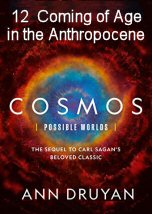
Coming of Age In The Anthropocene

   2020    Nature
At 11 o'clock on New Year's Eve of the Cosmic Calendar, Homo erectus stood up for the first time, freeing its hands and earning the species its name. They began to move around, to explore, daring to risk everything to get to unknown places. Our Neanderthal relatives lived much as we did and did many of the things we consider to be 'human.' More restless than their cousins the Neanderthals and Denisovans, our Homo sapiens ancestors crossed seas and unforgiving landscapes, changing the land, ocean and atmosphere, leading to mass extinction. The scientific community gave our age a new name, 'Anthropocene.'
Since the first civilizations we've wondered if there's something about human nature that contains the seeds of our destruction. Syukuro Manabe was born in rural Japan and took an intense interest in Earth's average global temperature. In the 1960's, he would assemble the evidence he needed to predict the increase of Earth's temperature due to greenhouse gases until it becomes an uninhabitable and toxic environment, leading to our extinction. 'This doesn't have to be,' says Neil deGrasse Tyson, 'it's not too late. There's another hallway, another future we can still have; we'll find a way.'
Series: Cosmos: Possible Worlds

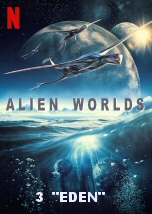
Eden

   2020    Science
Planets beyond our solar system are known to astronomers as exoplanets. They are at trillions of miles from Earth and yet, it might be possible to detect a faint signature of life in them. From the light of the stars they orbit that passes through the atmosphere of an exoplanet, it is possible to capture the chemical fingerprint of the elements in that atmosphere.
The fictional world Eden is orbiting not one star, but two. The light from its twin stars powers photosynthesis, pumping more oxygen into the atmosphere than in Earth, allowing life to thrive. Grazers are constantly alert to danger, because the canopy is home to predators perfectly evolved to live among the trees. In Episode 3, another topic are fungi and the role they could play on exoplanets. Ecologist Thomas Crowther talks about the role mycelial networks play in the Rothiemurchus forest in Scotland.
Series: Alien Worlds
Prehistoric Planet

Prehistoric Planet

2022  Science
Cooked

Cooked

2016  Culture
Chef's Table

Chef's Table

2017  Art
Atom

Atom

2007  Science
Life on Our Planet

Life on Our Planet

2023  Science
Strangest Things

Strangest Things

2021  History
Racism: A History

Racism: A History

2007  Culture