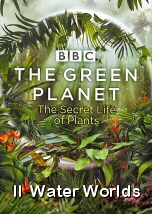
Water plants create some of the most beautiful, bizarre and important habitats on earth. To hold on in torrents, plants use a kind of superglue. Some are armed with vicious weapons to fight titanic battles for space. Others form perfect spheres and escape from animal enemies by rolling. Where nutrients are washed away, plants turn into hunters of animals, laying traps and even counting to ensure their success. In this episode we explore those watery worlds with David Attenborough, from Croatia to Brazil, from Colombia to Thailand, the brilliantly coloured flowers smother lakes, and in one magical river in Brazil, the water bubbles like champagne as plants create the atmosphere itself.
In the second episode, panic strikes the community as a full-blown catastrophe looms. Locals mobilize to confront the authorities and protest the nuclear power industry. Twenty-eight hours after the accident began, the lieutenant governor appeared at a news briefing to say that the plant's owner had assured the state that 'everything is under control'. Later that day, Scranton changed his statement, saying that the situation was 'more complex than the company first led us to believe'. There were conflicting statements about radioactivity releases. Schools were closed and residents were urged to stay indoors. Farmers were told to keep their animals under cover and on stored feed.
What If we could talk to animals? For as long as we've shared our lives with pets, we've been seeking better ways to communicate with them. In Washington state, Alexis Devine and her sheepadoodle Bunny think they've found a way of making communication a reality. Alexis went further than most, with a set of communication buttons, each programmed with a pre-recorded word to help humans and animals speak the same language. She has 90 buttons with which to express herself and even seems to combine them into simple sentences. Bunny is paving the way in pet communication. The undisputed masters of verbal communication are our pet parrots. They have mastered the art of vocal expression. Some parrots have even learned to fool devices designed to recognize human voices.
Our super friends in the animal world possess so many hidden superpowers. In the third episode we meet heat-seeking dogs, GPS-outfitted cats, and a sporty goldfish with squad goals. When we think we know them inside out, dogs surprise us with something new. what sensory superpower have dogs been hiding all this time? They have a thermal sensor in the tip of his nose. In the wild, a dog could use his thermal nose to spot the heat of a prey animal, allowing him to hunt even if his other senses were impaired. It also explains that uncanny knack for stealing a warm seat.
All of our pets survived for thousands of years in the wild without any help from us, and this has led them to develop astonishing athletic abilities which we sometimes take for granted. As greyster dogs and endurance champ tortoises. Dog scootering uses one or more dogs to pull a human riding an unmotorized scooter. Greysters are a naturally-athletic breed that can run at 20 miles per hour for five miles while handling these carriages. No other animal can run at this speed, exerting this power, and expending this energy for so long. So, what's their secret? Greysters' stride length can be a staggering 16 feet and they are super efficient at absorbing and using oxygen. Greyster dogs have nearly twice mitochondria inside their cells than humans.
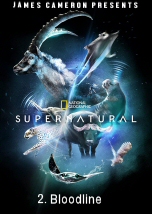
Continuing your bloodline is life's ultimate mission. In this unpredictable world, animals will do whatever it takes to keep their families safe. When family sticks together, communicating, collaborating and combining as one, everyone has the very best chance of survival. It takes every superpower possible to protect and provide for the family and secure the future for a new generation of amazing animals.
















In this episode we explore those watery worlds with David Attenborough, from Croatia to Brazil, from Colombia to Thailand, the brilliantly coloured flowers smother lakes, and in one magical river in Brazil, the water bubbles like champagne as plants create the atmosphere itself.