
Last Watched

"Ant "  Sort by

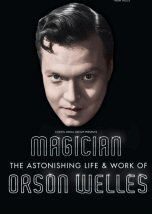
Magician: The Astonishing Life and Work of Orson Welles

   2014    Culture
This documentary looks at the remarkable genius of Orson Welles on his centenary - the enigma of his career as a Hollywood star, a Hollywood director (for some a Hollywood failure), and a crucially important independent filmmaker. Orson Welles's life was magical: a musical prodigy at age 10, a director of Shakespeare at 14, a painter at 16, a star of stage and radio at 20, romances with some of the most beautiful women in the world, including Rita Hayworth. His work was similarly extraordinary, most notably Citizen Kane, (considered by many to be the most important movie ever made), created by Welles when he was only 25. In the years following Citizen Kane, Welles's career continued to change as he made film after film (some never finished, many dismissed) and acted in other projects often to earn money in order to keep making his own films. Magician features scenes from almost every existing Welles film, from Hearts of Age, (which he made in a day when he was only 18 years old) to rarely-seen clips from his final unfinished works like The Other Side of the Dream, The Deep, and Don Quixote, as well as his television and commercial work.
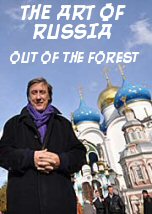
The Art of Russia: Out of the Forest

   2009    Art
Art critic Andrew Graham-Dixon tells the incredible story of Russian art, its mystery and magnificence and until now a story untold. He explores the origins of the Russian icon from its roots in Byzantium and the first great Russian icon, Our Lady of Vladimir to the masterpieces of the country's most famous icon painter, Andrei Rublev. Both epic and awe-inspiring, and producing brilliant art", nevertheless medieval Russia could be a terrifying place. Criss-crossing the epic landscape, Andrew visits the monastery founded by Ivan the Terrible, where his favourite forms of torture found inspiration in religious art. One man would shine a light into Russia's 'dark' ages - Peter the Great who, surprisingly, took as his inspiration Deptford in South London.
Series: The Art of Russia

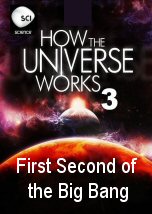
First Second of the Big Bang

   2014    Science
The first second of the Universe, the creation of everything when space, time, matter and energy burst into existence. It is the most important second in history, which seals the Universe's fate and defines everything that comes after - including us.
Series: How the Universe Works

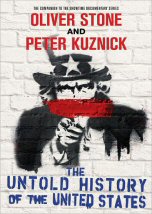
The Untold History of the United States: World War Two

   2012    History
This series, narrated and written by Oliver Stone and co-author Peter Kuznick, will focus on human events that at the time went under reported, but crucially shaped America’s unique and complex history over the 20th and 21st century. The series is a re-examination of some of the under-reported and darkest parts of American modern history using little known documents and newly uncovered archival material. The series looks beyond official versions of events to the deeper causes and implications and explores how events from the past still have resonant themes for the present day." The fist episode examines World War II. It offers special attention to the Spanish Civil War, Roosevelt's desire to enter the war on the side of the allies, the strategic Japanese decisions that lead up to Pearl Harbor Attack, and the often overlooked role that the Soviet Union had in winning the war.
Series: The Untold History of the United States

Giants

   2000    Science
Be prepared to fight your way past all kinds of computer animation. Somehow Patrick Moore's The Sky at Night manages to convey just as much excitement with little more than a couple of diagrams and the presenter's hyperactive enthusiasm. The series cover the history of the solar system and humanity's age-old desire to learn its secrets. Far beyond the inner planets of rock and iron lie the gas giants. Discover the most distant and alien worlds in our Solar System and the moment of genius that allowed scientists to explore them.
Series: The Planets

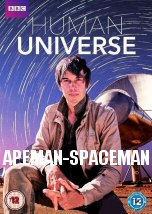
Apeman - Spaceman

   2014    History
Professor Brian Cox examines how it was that in a universe made of stars, rocks and endless space, a conscious civilisation was born. His latest adventure takes him from a submerged space station in Star City on the outskirts of Moscow, to Ethiopia, high above in the Great Rift Valley, where he encounters the geladas, mankind's distant ancestors. Despite once being Africa's most successful primate, a species who at one time roamed across the entire continent, these days they are found in one just place in the remote Ethiopian Highlands. Cox investigates why these ancestors retreated, yet modern mankind has expanded across the planet.
Series: Human Universe