


Last Watched

"ELA"  Sort by

The Time Travel

   2010    Science
One of the Universe's most enduring mysteries is Time Travel. In this episode, we explore the possibilities. Discover why Time Travel into the future is unavoidable in the Einsteinian world of Relativity. As for the past... the laws of physics do not tell us it's impossible, but the bizarre consequences of going into the past and altering the future make for mind-bending science. Finally, we go for the future by traveling to the nearest star, 4.3 light years away... in only 45 days. Our destination may be an Earth-like planet; a planet scientists are now hunting for, and may find in the next 3 to 4 years.
Series: The Universe
Light Speed

   2008    Science
According to the laws of physics we can never travel faster than the speed of light...or can we? Learn all about light speed, the ultimate constant in the universe.
Series: The Universe

Sex in Space

   2008    Technology
As man moves to colonize the cosmos, the realities of sexual relationships and reproduction need to be addressed. Probe the physiological, psychological and cultural challenges of sex in space.
Series: The Universe

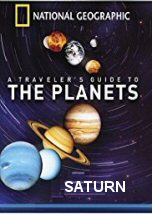
Saturn

   2011    Science
No planet beats Saturn for jaw-dropping beauty. Saturn is the most photogenic planet in all the solar system. Some of the pictures are to die for. But the postcards only tell part of the story. It really is rolling and seething inside. For ringside action, soar above the planet with its six-sided storms. Even more mystery surrounds the impressive Fountains of Enceladus where the secrets of life might spring from the moons salty geysers. And the samples are coming out in space, there's a big sign there: Free Samples: Take One.
Series: A Traveler Guide to the Planets

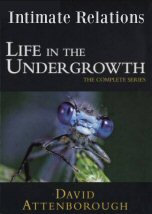
Intimate Relations

   2005    Nature
The world of invertebrates exists in a web of relationships with plants and other animals. Unique footage of the world's smallest insect (a fairy wasp only quarter of a millimetre long) shows it flying underwater to find the eggs of water beetles in which to lay its own brood. Some ants 'farm' the trees that give them shelter, creating areas known as 'Devil's gardens'. To make sure these grow without competition, they kill off other seedlings in the surrounding vegetation. The blister beetle's larvae huddle together on the end of a piece of grass and mimic a female bee. When a male bee tries to mate with the 'female', the larvae grab on to his belly. Confused, he flies away and searches for a real female. When he eventually finds her and mates with her, the beetle larvae hurriedly swap from his front on to her back, and hence get carried back to her nest where they eat her pollen supplies.
Series: Life in the Undergrowth

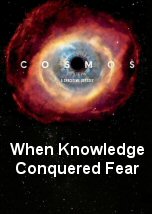
When Knowledge Conquered Fear

   2014    Science
The episode begins with Tyson describing how pattern recognition manifested in early civilization as using astronomy and astrology to predict the passing of the seasons, including how the passage of a comet was often taken as an omen. Tyson continues to explain that the origin of comets only became known in the 20th century due to the work of Jan Oort and his hypothesis of the Oort cloud. Tyson then continues to relate the collaboration between Edmond Halley and Isaac Newton in the last part of the 17th century in Cambridge. The collaboration would result in the publication of Philosophiæ Naturalis Principia Mathematica, the first major work to describe the laws of physics in mathematical terms, despite objections and claims of plagiarism from Robert Hooke and financial difficulties of the Royal Society of London. Tyson explains how this work challenged the prevailing notion that God had planned out the heavens, but would end up influencing many factors of modern life, including space flight. Tyson further describes Halley's contributions including determining Earth's distance to the sun, the motion of stars and predicting the orbit of then-unnamed Halley's Comet using Newton's laws. Tyson contrasts these scientific approaches to understanding the galaxy compared to what earlier civilizations had done, and considers this advancement as mankind's first steps into exploring the universe. The episode ends with an animation of the Milky Way and Andromeda galaxies' merging based on the principles of Newton's laws.
Series: Cosmos: A Spacetime Odyssey