Every year grizzly bear families in North America depend for their survival on a spectacular natural event: the return of hundreds of millions of salmon from the Pacific Ocean to the mountain streams where they were born. The salmon travel thousands of miles to spawn and then die. The great run not only provides food for bears, but for killer whales, wolves, bald eagles, and even the forest itself. The question is: will the salmon return in time to keep hungry bears alive? A mother grizzly and her cubs emerge from their den high in snowy Alaskan mountains. Filming from the air the team capture a TV first, following the bears as they negotiate a near vertical slope on their journey to the coast where they await the return of the salmon. Meanwhile, the salmon are making their way to the to river mouths where they must swim upstream and against the current. The programme reveals how they tackle the torrents and leap over waterfalls, a feat equivalent to a human jumping over a house. Dozens of hungry bears eagerly await the salmon that make it up river. In another TV first, underwater cameras record the ingenuity and fancy footwork they use to collect dead salmon from the bottom of deep pools.
Of all the objects in the cosmos, planets, stars, galaxies, none are as strange, mysterious, or powerful as black holes. Black holes are the most mind-blowing things in the universe. They can swallow a star completely intact. Black holes have these powerful jets that just spew matter out. First discovered on paper, on the back of an envelope, some squiggles of the pen. The bizarre solution to a seemingly unsolvable equation, a mathematical enigma. Einstein himself could not accept black holes as real. People didn't even believe for many years that they existed. Nature doesn't work that way. Yet slowly, as scientists investigate black holes by observing the effect they have on their surroundings, evidence begins to mount.
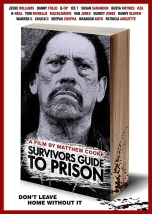
'It's really about terror and intimidation and people basically fighting for survival and often committing extraordinary violence in order to protect themselves or to stay safe. It's kind of like the weak dog in the pack. If others spot weakness, they're gonna pounce on you for a couple of reasons. You pounce on that guy, that gives you a little more status. So, I had to ask myself, are you gonna be a victim? No, I ain't gonna be a victim. Well, that really only left me one choice in my mind. That means I gotta be the victimizer. At some point, for some reason, might be legitimate, might not be, someone's gonna test you.. Even if you lose, you're gonna have to stand up for yourself. ' 'A guy comes over, and it's your day to get your package, and he tries to take your package from you that your people sent you, if you let him do it, there's gonna be 10 other dudes, oh, yeah, he let that guy take his package, I'm gonna go get his TV, right down the line until somebody's after your ass. But if you stand up that first time and they see you'll stand up for yourself, even if you lose, people will respect that. Oh, don't mess with him. There's easier prey. Why do you have to go and get that guy and get a couple lumps for it when he can go get that guy's stuff over there, don't cost you nothing. It usually only has to happen once or twice but just as importantly that you didn't go to the man for help... you're gonna be all right.'
Nancy Silverton describes her life path involving both Los Angeles and Italy, her family and her obsession with bread. She was born in Sherman Oaks, CA in a family where going out to eat was considered a special treat. But when she entered college and found herself 'very attracted by a handsome man' who worked in a kitchen, she landed herself a job and a new passion. These details, which all lead up to her stint at Wolfgang Puck’s celebrated LA restaurant Spago in 1982, are intercut with present-day scenes of Silverton working at Osteria Mozza.
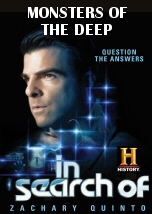
Zachary Quinto sets out to research the strangest creatures dug up from the depths of the ocean and to see how much they lend to the monsters that are depicted in myth and legend. Starting in Australia, he meets with a teenager who was savagely attacked by a swarm of mysterious flesh-eating monsters, only to jump into the water himself the next day amongst highly venomous sea creatures. From the carnivorous fish of American rivers to the eyeless monsters of the Atlantic Ocean, Zachary finds some merit in these old monster stories and is starting to understand just what we mean when we say that we know less than 1% of what waits in the depths below.
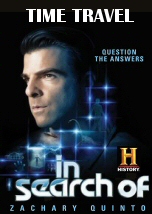
Zachary Quinto charts a journey to determine whether time travel is possible. He meets a man who claims to have traveled back in time due to a secret government program and a group of people living in Liverpool known as 'time slippers'. Zachary makes a visit to the CERN headquarters in Geneva, where he attempts to understand the origins of the universe and the dimension of time. Equipped with this new knowledge, Zachary tests his own perception of time with an elaborate skydiving experiment to see if he can slow down time itself.














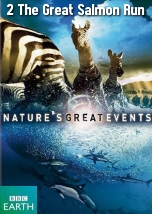







A mother grizzly and her cubs emerge from their den high in snowy Alaskan mountains. Filming from the air the team capture a TV first, following the bears as they negotiate a near vertical slope on their journey to the coast where they await the return of the salmon. Meanwhile, the salmon are making their way to the to river mouths where they must swim upstream and against the current. The programme reveals how they tackle the torrents and leap over waterfalls, a feat equivalent to a human jumping over a house. Dozens of hungry bears eagerly await the salmon that make it up river. In another TV first, underwater cameras record the ingenuity and fancy footwork they use to collect dead salmon from the bottom of deep pools.