Following the wildly successful 'Cosmos: A Spacetime Odyssey,' Neil deGrasse Tyson returns as host to translate more revelations of science into a lavish transporting experience, taking audiences on a series of spiritual voyages of exploration. The show reveals previously uncharted realms, including lost worlds, worlds yet to come, and the worlds that humans may one day inhabit. Ann Druyan, original creative collaborator to Carl Sagan, whose iconic docuseries 'Cosmos' provided inspiration for this series, serves as executive producer alongside Seth MacFarlane. Episode 1 takes viewers on a wild ride with the Ship of Imagination in an adventure spanning billions of years into the evolution of life.
The second episode takes a look at how humans have always been voyagers and explorers, leaving the comfort of native shores to explore. Neil DeGrasse Tyson will show us a long-term vision of humanity's future worlds.
We inhabit a cosmos of undiscovered dimensions and paradoxical realities. We live on one level of perception, but there are others. Every once in a while, a searcher happens upon the doorway to one of these other levels. One of them discovered a paradox about reality that proved to be so profound, we have yet to understand how it could be possible. The universe, or perhaps we should say, universes have never been the same. In the counterintuitive realm of quantum mechanics, light can be two contradictory things, and somehow - no one knows how - an unseen observer can alter the nature of reality. The man who stumbled on this hole in reality and the still- unfolding technological revolution that it made possible.
At 11 o'clock on New Year's Eve of the Cosmic Calendar, Homo erectus stood up for the first time, freeing its hands and earning the species its name. They began to move around, to explore, daring to risk everything to get to unknown places. Our Neanderthal relatives lived much as we did and did many of the things we consider to be 'human.' More restless than their cousins the Neanderthals and Denisovans, our Homo sapiens ancestors crossed seas and unforgiving landscapes, changing the land, ocean and atmosphere, leading to mass extinction. The scientific community gave our age a new name, 'Anthropocene.' Since the first civilizations we've wondered if there's something about human nature that contains the seeds of our destruction. Syukuro Manabe was born in rural Japan and took an intense interest in Earth's average global temperature. In the 1960's, he would assemble the evidence he needed to predict the increase of Earth's temperature due to greenhouse gases until it becomes an uninhabitable and toxic environment, leading to our extinction. 'This doesn't have to be,' says Neil deGrasse Tyson, 'it's not too late. There's another hallway, another future we can still have; we'll find a way.'
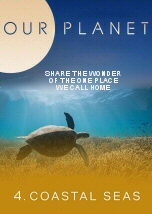
Immense shoals of fish throng our shallow seas. Small fish, in turn, sustain bigger ones. The rich coastal seas are the fishing grounds of our planet and can provide an abundance of food for wildlife and humanity. The seas fringing land make up less than a tenth of the world's oceans but 90 percent of marine creatures live in coastal waters, from fearsome sharks to lowly urchins. Protecting these habitats is a battle humanity must win.
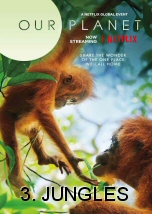
A rain forest is the richest habitat on Earth. Exactly how many species rain forests contain is unknown, but it runs into millions. And new ones are discovered every week. There are some, like the clouded leopard, we still know virtually nothing about. Although they cover just seven percent of the world's land area, jungles play a vital role in the health of the planet . Jungles and rainforests are home to an incredible variety of species like preening birds, intelligent orangutans and remarkably ambitious ants.















Episode 1 takes viewers on a wild ride with the Ship of Imagination in an adventure spanning billions of years into the evolution of life.