







Last Watched

"ELA"  Sort by

Who Will We Be

   2015    Medicine
In ‘Who will we be?’ Dr. David Eagleman journeys into the future, and asks what’s next for the human brain, and for our species. We stand at a major turning point, one where we might take control of our own development. We face a future of uncharted possibilities in which our relationship with our own body, our relationship with the world, the very basic nature of who we are is set to be transformed. For thousands of generations, humans have lived the same life cycle over and over. We are born, we control a fragile body, we experience a limited reality, and we die. But science and technology are giving us tools to transcend that evolutionary story. Our brains don't have to remain as we have inherited them. We are capable of extending our reality, of inhabiting new bodies, and possibly shedding our physical forms altogether. And we are discovering the tools to shape our own destiny. Who we become is up to us.
Series: The Brain with David Eagleman
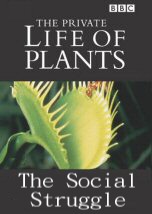
The Social Struggle

   1995    Nature
Fourth episode examines how plants either share environments harmoniously or compete for dominance within them. Attenborough highlights the 1987 hurricane and the devastation it caused. However, for some species, it was that opportunity for which they had lain dormant for many years. The space left by uprooted trees is soon filled by others who move relatively swiftly towards the light. The oak is one of the strongest and longest-lived, and other, lesser plants nearby must wait until the spring to flourish before the light above is extinguished by leaves. Tropical forests are green throughout the year, so brute force is needed for a successful climb to the top of the canopy: the rattan is an example that has the longest stem of any plant. As its name suggests, the strangler fig 'throttles' its host by growing around it and cutting off essential water and light. Some can take advantage of a fallen tree by setting down roots on the now horizontal trunk and getting nutriment from the surrounding moss and the fungi on the dead bark. The mountain ash (eucalyptus regnans) grows so tall, that regeneration becomes a considerable problem. It is easily flammable, so its solution is to shed its seeds during a forest fire and sacrifice itself. It therefore relies on the periodic near-destruction of its surroundings in order to survive. Attenborough observes that catastrophes such as fire and drought, while initially detrimental to wildlife, eventually allow for deserted habitats to be reborn.
Series: The Private Life of Plants

The Private Life of Plants Living Together

   1995    Nature
The fifth programme explores the alliances formed between the animal and plant worlds. Attenborough dives into Australia's Great Barrier Reef and contrasts the nocturnal feeding of coral, on microscopic creatures, with its daytime diet of algae. Some acacias are protected by ants, which will defend their refuge from any predator. Besides accommodation, the guards are rewarded with nectar and, from certain species, protein for their larvae as well. Fungi feed on plants but can also provide essential nutriment to saplings (Mycorrhiza). The connection is never broken throughout a tree's life and a quarter of the sugars and starches produced in its leaves is channelled back to its fungal partners. Meanwhile, fungi that feed on dead wood leave a hollow trunk, which also benefits the tree. Orchids enjoy a similar affiliation. Lichens are the product of a relationship between fungi and a photosynthetic associate, usually algae. They are extremely slow-growing, and a graveyard is the perfect location to discover their exact longevity. Mistletoe is a hemiparasite that obtains its moisture from a host tree, while using own leaves to manufacture food. Its seeds are deposited on another by the mistletoe tyrannulet, following digestion of the fruit. The dodder (Cuscuta) is also parasitic, generally favouring nettles, and siphons its nourishment through periodic 'plugs' along its stem. The rafflesia has no stem or leaves and only emerges from its host in order to bloom — and it produces the largest single flower: one metre across.
Series: The Private Life of Plants

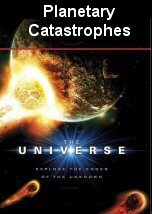
Catastrophes that Changed the Planets

   2011    Science
The planets of our solar system have experienced epic catastrophes throughout their long history, both raining down from outside and bubbling up from within. We'll voyage back in time to investigate the violent events that profoundly shaped the planets, including earth itself. We'll witness stunning revelations about what transformed Mars into a barren, hostile desert... The disaster that changed Venus from temperate to hellish... The impact that blew away Mercury's mantle, turning it into a planetary core... A colossal disturbance that rearranged the orbits of the gas giants... Titanic impacts on Jupiter... And how a lost moon may finally explain Saturn's rings.
Series: The Universe

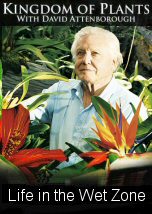
Kingdom of Plants Life in the Wet Zone

   2012    Nature
Written and presented by David Attenborough, who said: 'One of the most wonderful things about filming plants is that you can reveal hidden aspects of their lives, you can capture the moment as one plant strangles another, and as they burst into flower. But whilst time-lapse photography allows you to see things that no human being has ever seen before". David begins his journey inside the magnificent Palm House, a unique global rainforest in London. Here, he explores the extraordinary plants that are so well adapted to wet and humid environments and unravels the intimate relationships between wet zone plants and the animals that depend on them. It was in the wet zones of the world that plants first moved on to land and in the Waterlily House David reveals how flowers first evolved some 140 million years ago. Watching a kaleidoscope of breath-taking time-lapses of these most primitive of flowers swelling and blooming in 3D, he is able to piece together the very first evolutionary steps that plants took to employ a wealth of insects to carry their precious pollen for the first time. David discovers clues to answer a question that even had Charles Darwin stumped: how did flowering plants evolve so fast to go on to colonise the entire planet so successfully?
Series: Kingdom of Plants

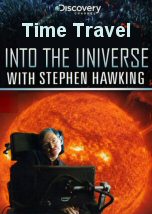
Time Travel

   2010    Science    HD
Is Time Travel Possible? Stephen Hawking explores the world's favourite scientific 'what if?' He explores all the possibilities, warping the very fabric of time and space as he goes. From killing your grandfather to riding a black hole, we learn the pitfalls and the prospects for a technology that could quite literally, change everything.
Series: Into The Universe with Stephen Hawking
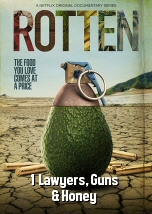
Rotten

Rotten

2018  Nature
Vegan

Vegan

2020  Culture
Building Giants

Building Giants

2019  Technology
Top Science Stories

Top Science Stories

2020  Science
Leaving Neverland

Leaving Neverland

2019  Culture
Walking with Dinosaurs

Walking with Dinosaurs

2025  Science