Planets beyond our solar system are known to astronomers as exoplanets. They are at trillions of miles from Earth and yet, it might be possible to detect a faint signature of life in them. From the light of the stars they orbit that passes through the atmosphere of an exoplanet, it is possible to capture the chemical fingerprint of the elements in that atmosphere. The fictional world Eden is orbiting not one star, but two. The light from its twin stars powers photosynthesis, pumping more oxygen into the atmosphere than in Earth, allowing life to thrive. Grazers are constantly alert to danger, because the canopy is home to predators perfectly evolved to live among the trees. In Episode 3, another topic are fungi and the role they could play on exoplanets. Ecologist Thomas Crowther talks about the role mycelial networks play in the Rothiemurchus forest in Scotland.
Global CO2 emissions coming from aviation will go from about 2% to, by 2050, something closer to 20%. Technology is the only key to open up a brighter future that can be sustainable at the same time. The way we fly is about to change, driven by a new breed of aviators not afraid to think differently. From clean, green electric aircraft to autonomous sky taxis, could the days of the jet age be numbered?
Without the chemistry of photosynthesis, ozone, and a molecule called Rubisco, none of us would be here. So how did we get so lucky? To find out, host David Pogue investigates the surprising molecules that allowed life on Earth to begin, and ultimately thrive. Along the way, he finds out what we’re all made of—literally.
Just about every solid, liquid, or gas in the world as we know it begins with reactions between individual atoms and molecules. Host David Pogue dives into the transformative world of chemical reactions, from the complex formula that produces cement to the single reaction that’s allowed farmers to feed a global population by the billions.
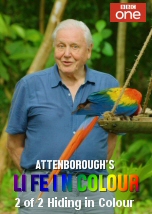
David Attenborough reveals the extraordinary ways that some animals use colour to hide and disappear into the background. New science reveals how the Bengal tiger in central India uses its orange-black stripes to hide from its colour-blind prey. In Kenya’s Masai Mara, the zebra’s black-and-white pattern confuses predators with an extraordinary effect called motion dazzle. And on the island of Cuba, a small snail uses colourful stripes in a surprising way to hide from its enemies. Other animals use colour to trick and to deceive. On Australia’s Great Barrier Reef, a blue-striped blenny uses colours to mimic other fish and launch a sudden attack. In the grasslands of Zambia, the chick of a pin-tailed whydah mimics the patterns of its nest mates to ensure that it is not detected as an imposter. And specialist cameras reveal how a tiny crab spider uses bright ultraviolet colours to lure in its victims.
Ten years after waging a bloody campaign to gain control over his own province, powerful samurai warlord Oda Nobunaga has seized much of Central Japan, including the nation’s capital, Kyoto. Now, driven by a towering ambition, he dreams of crushing the powerful clans who still oppose his rule. And for the first time in over a century, uniting all of Japan under one banner. But Nobunaga’s legendary brutality has caused widespread anger. Across the nation, powerful enemies now plot his demise.










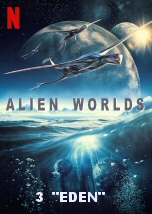








The fictional world Eden is orbiting not one star, but two. The light from its twin stars powers photosynthesis, pumping more oxygen into the atmosphere than in Earth, allowing life to thrive. Grazers are constantly alert to danger, because the canopy is home to predators perfectly evolved to live among the trees. In Episode 3, another topic are fungi and the role they could play on exoplanets. Ecologist Thomas Crowther talks about the role mycelial networks play in the Rothiemurchus forest in Scotland.