




Last Watched

"Extinction"  Sort by

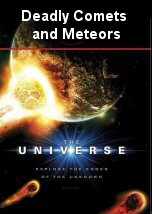
Deadly Comets and Meteors

   2009    Science
Right now cosmic forces prowl the universe and threaten man's very existence. They're asteroids and comets; they've left their imprint on planet Earth, literally. Initially helping to build planets through violent collisions, during this fiery bombardment period they may have even seeded Earth with water and the building blocks for life. Since the turbulent formation of the solar system, these space rocks have continued to impact Earth. Some have been so violent that they've led to mass extinctions, including one that wiped out the dinosaur. New theories suggest that asteroid and comet dust harbour deadly viruses that may have triggered some of our worst pandemics. The possibility of future collisions remains a legitimate threat yet despite their dangers, asteroids and comets may hold vital natural resources, which could actually preserve
Series: The Universe
Stopping Armageddon

   2009    Technology
It sounds like a Hollywood blockbuster: a deadly asteroid is on a collision course with Earth. But in reality, it's only a matter of time before a giant space rock threatens to wipe out civilization. An asteroid took out the dinosaurs sixty-five million years ago. Are we next? This episode analyzes the threat and explores the many ways--from a nuclear bomb to ingenious new technology--that experts are proposing to stop Armageddon
Series: The Universe

Some of the Things That Molecules Do

   2014    Science    HD
The story begins with Tyson sitting at a campfire, and telling how the wolf changed through artificial selection, and selective breeding into the dog breeds around today. He then enters the Ship of Imagination, and explains natural selection with the process that helped to create the polar bears. Along the way he talks about DNA, genes and mutation. Next he goes to a forest and describes the Tree of life, this leads him to discussing the evolution of the eye. He then discusses extinction, by going to a monument called the Halls of Extinction, dedicated to the broken branches of the tree of life. Explaining the five great Extinction events. He then tells how some life has survived, and then focuses on the tardigrade. From there he talks about what other kinds of life might have been created on other worlds. He then goes to Saturn's moon Titan. From there he speculates about life and how it first began. He then returns to Earth and tells about abiogenesis and how life changed and evolved. The show ends with an animated sequence from the original series of life's evolution from one cell to humans.
Series: Cosmos: A Spacetime Odyssey

The Lost Worlds of Planet Earth

   2014    Science
This episode explores the palaeogeography of Earth over millions of years, and its impact on the development of life on the planet. Tyson starts by explaining that the lignin-rich trees evolved in the Carboniferous era about 300 million ago, then explains on the nature of plate tectonics that would shape the landmasses of the world and the asteroid impact that initiated the Cretaceous–Paleogene extinction event, leaving small mammals as the dominate species on earth. Earth's landmasses are expected to change in the future and postulates what may be the next great extinction event.
Series: Cosmos: A Spacetime Odyssey

Worst Days on Planet Earth

   2011    Nature    3D    HD
Earth may seem like the most hospitable planet in the solar system. But look again. Startling new discoveries reveal the blue planet has been plagued by more chaos and destruction than scientists once imagined. Stand on the Earth billions of years ago as a primitive planet called Theia slams into it. Shiver as our entire globe is frozen over like a gigantic snowball. Feel the heat as mammoth volcanoes scorch the landscape and darken the sky. From a cosmic gamma ray burst frying away the ozone layer to an Everest-size asteroid slamming into the ocean, we'll reveal new information about how these unparalleled events drove life to the brink of total extinction. Out of this continuous devastation, how has our planet--and life--got to where it is today? Are the worst days behind us--or lurking in the distant future?
Series: The Universe

Orthodoxy From Empire to Empire

   2011    Culture
In the third part of his journey into the history of Christianity, Professor Diarmaid MacCulloch charts Orthodoxy's extraordinary fight for survival. After its glory days in the eastern Roman Empire, it stood right in the path of Muslim expansion, suffered betrayal by crusading Catholics, was seized by the Russian tsars and faced near-extinction under Soviet communism. MacCulloch visits the greatest collection of early icons in the Sinai desert, a surviving relic of the iconoclastic crisis in Istanbul and Ivan the Terrible's cathedral in Moscow to discover the secret of Orthodoxy's endurance.
Series: A History of Christianity
Human

Human

2025  History
Tiger

Tiger

2020  History
Alien Worlds

Alien Worlds

2020  Science
Wonders of Life

Wonders of Life

2013  Science
Mind Field

Mind Field

2019  Medicine
Frozen Planet

Frozen Planet

2011  Nature
Prehistoric Planet

Prehistoric Planet

2022  Science