Every year, around the world, seasonal changes transform entire landscapes and draw in millions of creatures as these great events unfold. This fantastic series combines the epic scale of Planet Earth and the intimate, emotional stories of charismatic animals as they struggle to survive. Using state of the art technology, these programmes capture the Earth's most dramatic and epic wildlife spectacles and the intimate stories of the animals caught up in them. The Great Melt: The summer melt of Arctic ice, opening up nearly three million square miles of ocean and land, provides opportunities for millions of animals, including beluga whales, families of Arctic foxes, vast colonies of seabirds, and the fabled Arctic unicorn, the narwhal. For polar bears, however, it is the toughest time of year. Why? How will they survive? A mother polar bear and her cub make their first journey together onto the sea ice. They are looking for ringed seals, their favourite prey. It is a serious business but the cub just wants to play. The melting ice makes it harder for them to hunt and threatens their survival. In a unique aerial sequence, the migration of narwhal with their distinctive unicorn-like tusks is filmed for the first time. The whales' journey is risky as they travel along giant cracks in the ice. If the ice were to close above them, they would drown. Hundreds of beluga whales gather in the river shallows. They rub themselves on smooth pebbles in one of the most bizarre summer spectacles. Guillemot chicks take their first flights from precipitous sea cliff nests to the sea 300 metres below. They attempt to glide to safety but many miss their target. Their loss is a bonus for the hungry Arctic fox family waiting below. As the melt comes to an end the bears gather, waiting for the sea to freeze again. Two 400kg males square up to each other to spar.
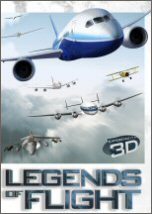
A film that will not only delight and entertain the aviation enthusiast but also educate and inspired renewed interest in aviation by the traveling public, the media and young people who may ultimately aspire to a career in aviation. It dramatized the design challenged, the financial risks and the many lessons learned from a century of aviation trial and error, bringing us to the dawn of a new era of revolutionary aircraft, the 787 Dreamliner and the A380". The film will focus on the 787 to facilitate audience understanding of the dynamic design differences between the two latest aircraft technologies. Search aviation history for the ultimate flying experience with some of today's greatest pilots. See how the airplanes of the 20th century helped influence the radical new design of 21st century aircraft. See how high tech manufacturers around the world use modern technology to coordinate the design and construction of new aircraft. Fly in the cockpit with chief test pilot, Mike Carriker, as he takes the new 787 Dreamliner on its first test flight.
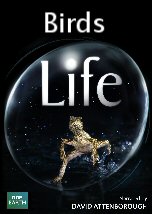
Birds owe their global success to feathers - something no other animal has. They allow birds to do extraordinary things. For the first time, a slow-motion camera captures the unique flight of the marvellous spatuletail hummingbird as he flashes long, iridescent tail feathers in the gloomy undergrowth. Aerial photography takes us into the sky with an Ethiopian lammergeier dropping bones to smash them into edible-sized bits. Thousands of pink flamingoes promenade in one of nature's greatest spectacles. The sage grouse rubs his feathers against his chest in a comic display to make popping noises that attract females. The Vogelkop bowerbird makes up for his dull colour by building an intricate structure and decorating it with colourful beetles and snails.
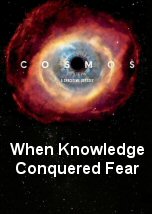
The episode begins with Tyson describing how pattern recognition manifested in early civilization as using astronomy and astrology to predict the passing of the seasons, including how the passage of a comet was often taken as an omen. Tyson continues to explain that the origin of comets only became known in the 20th century due to the work of Jan Oort and his hypothesis of the Oort cloud. Tyson then continues to relate the collaboration between Edmond Halley and Isaac Newton in the last part of the 17th century in Cambridge. The collaboration would result in the publication of Philosophiæ Naturalis Principia Mathematica, the first major work to describe the laws of physics in mathematical terms, despite objections and claims of plagiarism from Robert Hooke and financial difficulties of the Royal Society of London. Tyson explains how this work challenged the prevailing notion that God had planned out the heavens, but would end up influencing many factors of modern life, including space flight. Tyson further describes Halley's contributions including determining Earth's distance to the sun, the motion of stars and predicting the orbit of then-unnamed Halley's Comet using Newton's laws. Tyson contrasts these scientific approaches to understanding the galaxy compared to what earlier civilizations had done, and considers this advancement as mankind's first steps into exploring the universe. The episode ends with an animation of the Milky Way and Andromeda galaxies' merging based on the principles of Newton's laws.
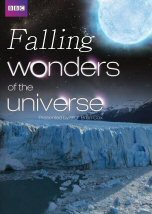
Professor Brian Cox takes on the story of the force that sculpts the entire universe - gravity. Gravity seems so familiar, and yet it is one of the strangest and most surprising forces in the universe. Starting with a zero gravity flight, Brian experiences the feeling of total weightlessness, and considers how much of an effect gravity has had on the world around us. But gravity also acts over much greater distances. It is the great orchestrator of the cosmos. It dictates our orbit around the sun, our relationship with the other planets in our solar system, and even the way in which our solar system orbits our galaxy. Yet the paradox of gravity is that it is actually a relatively weak force. Brian takes a face distorting trip in a centrifuge to explain how it is that gravity achieves its great power, before looking at the role it plays in one of the most extraordinary phenomena in the universe - a neutron star. Although it is just a few kilometres across, it is so dense that its gravity is 100, 000 million times as strong as on Earth. Over the centuries our quest to understand gravity has allowed us to understand some of the true wonders of the universe, and Brian reveals that it is scientists' continuing search for answers that inspires his own sense of wonder.
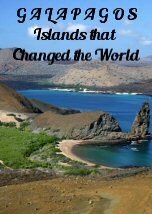
From flightless cormorants hunting underwater to giant tortoises courting on the rim of an active volcano, a look at the hidden side of Galapagos, revealing why it is such a fascinating showcase for evolution.








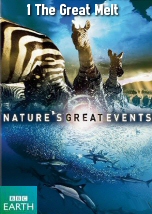

The Great Melt: The summer melt of Arctic ice, opening up nearly three million square miles of ocean and land, provides opportunities for millions of animals, including beluga whales, families of Arctic foxes, vast colonies of seabirds, and the fabled Arctic unicorn, the narwhal. For polar bears, however, it is the toughest time of year. Why? How will they survive? A mother polar bear and her cub make their first journey together onto the sea ice. They are looking for ringed seals, their favourite prey. It is a serious business but the cub just wants to play. The melting ice makes it harder for them to hunt and threatens their survival. In a unique aerial sequence, the migration of narwhal with their distinctive unicorn-like tusks is filmed for the first time. The whales' journey is risky as they travel along giant cracks in the ice. If the ice were to close above them, they would drown. Hundreds of beluga whales gather in the river shallows. They rub themselves on smooth pebbles in one of the most bizarre summer spectacles. Guillemot chicks take their first flights from precipitous sea cliff nests to the sea 300 metres below. They attempt to glide to safety but many miss their target. Their loss is a bonus for the hungry Arctic fox family waiting below. As the melt comes to an end the bears gather, waiting for the sea to freeze again. Two 400kg males square up to each other to spar.