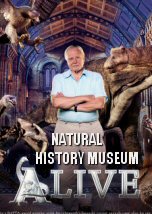
In this ground-breaking film, Sir David Attenborough takes us on a journey through the world-famous Natural History Museum in London in a captivating tale of discovery, adventure, and magic, where state-of-the-art CGI, science, and research combine to bring the museum's now long-extinct inhabitants to life to discover how these animals once roamed the planet. As the doors are locked and night falls, Attenborough stays behind and meets some of the most fascinating extinct creatures which come alive in front of his eyes; dinosaurs, ice age beasts, and giant reptiles. The film fulfils a lifelong dream of him, who said: 'I have been coming to the Natural History Museum since I was a boy. It's one of the great places to come to learn about natural history. In this film we have the technology to bring back to life some of the most romantic and extraordinary extinct creatures that can be conceived; some are relatively recent animals like the dodo, others older like the dinosaurs, and some we only know through fossil evidence. Using our current scientific knowledge, this film brings these creatures alive, allowing me to look at some of the biggest questions surrounding them.'
Many argue that flying saucers and other extra-terrestrial space ships continuously visit the earth. If that were true, what kinds of technologies would such alien spacecraft require? And do eyewitness reports of UFO sightings jibe with modern theories of how interstellar travel might be possible? Authors, astronomers and theoretical physicists weigh in with the blueprints for inertia-canceling devices, nuclear-powered craft, antimatter propulsion systems and even warp drives. Based on Einstein's theories and countless scientific studies, we'll find out how these visitors might bridge the vast distances between the stars. And if they could survive such hazardous journeys, are they flesh and blood or intelligent machines?
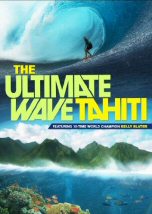
The stunning beauty of an island paradise on a quest to find the perfect wave-riding experience. Nine-time world surfing champion Kelly Slater and Tahitian surfer Raimana Van Bastolaer and a group of friends seek out the best waves breaking on the reef at Tahiti's famed surf site Teahupo'o. As their quest unfolds, the audience is plunged beneath the surface of things, to explore the hidden forces at work shaping ocean waves and the islands that lie in their path. Amidst playful surfing action, we navigate the cosmos and an ocean storm in a search for the source and nature of a wave's energy. Exploring mountainous Tahiti, we are thrust into the turbulent volcanic past of the island and its neighbours and discover the seagoing, wave-riding roots of the islanders themselves -- a culture still rich in the music, dance and lore of the sea. Beneath the ocean, swimming with our surfers, we explore the stunning, fragile beauty of the reef habitat -- a turbulent, wave-shaping interface that envelops the island and nurtures the ocean's multitudes in motion -- fish, dolphins, sharks and whales. When the truly big surf arrives at Teahupo'o, surfing play becomes surfing survival as the riders artfully tackle some of the heaviest surf on the planet -- spectacularly captured for the giant screen in 3D for the first time.
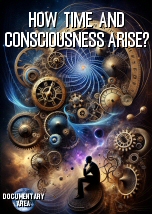
Physicist Jim Al-Khalili embarks on an extraordinary quest through 600 million years of evolution to reveal how the human brain — the most complex structure known in the universe — came to exist. With more than 100 billion neurons and 100 trillion connections, it surpasses even the stars of the Milky Way. Through breathtaking science and striking visuals, this documentary uncovers how nature transformed simple nerve cells into the ultimate thinking machine. From the first survival instincts of primates to the dawn of social intelligence, Jim explores how cooperation, relationships and empathy reshaped the brain and made us who we are. Working alongside his wife and leading researchers, he dives into fossil evidence, brain scans and the rise of artificial intelligence to answer one profound question: what makes the biological brain so unique — and can anything ever match it?
A harrowing yet essential documentary uncovers the avoidable disaster that claimed 72 lives in one of the UK’s worst residential fires. Through powerful testimonies of survivors, families and firefighters, the film reveals how a series of decisions—by authorities, contractors and building managers—turned a seemingly routine refurbishment into a catastrophic inferno. Exploring decades of warnings ignored, regulatory failure and corporate negligence, the documentary stitches together hidden emails, inquiry evidence and personal pain to show exactly how this tragedy wasn't just a fire, but a systemic collapse. It is both a memorial for the lost and a call for justice for those still fighting the consequences.
This documentary celebrates the life of John Candy, a comedy legend whose warmth and humor defined a generation and who died of a heart attack in 1994 at the age of 43. Through rare footage and honest interviews with family, friends, and fellow stars, it reveals the man behind the laughter — talented, humble, and deeply human. From his early days in television to his rise as one of Hollywood’s most beloved comedic actors, his story shows how joy and vulnerability shaped a career that continues to inspire. With reflections from Bill Murray, Eugene Levy, Catherine O’Hara, and Dan Aykroyd, the film captures Candy’s lasting legacy as both a comic genius and a kind soul whose influence still endures decades after his passing.






The film fulfils a lifelong dream of him, who said: 'I have been coming to the Natural History Museum since I was a boy. It's one of the great places to come to learn about natural history. In this film we have the technology to bring back to life some of the most romantic and extraordinary extinct creatures that can be conceived; some are relatively recent animals like the dodo, others older like the dinosaurs, and some we only know through fossil evidence. Using our current scientific knowledge, this film brings these creatures alive, allowing me to look at some of the biggest questions surrounding them.'