




Last Watched

"Disco"  Sort by

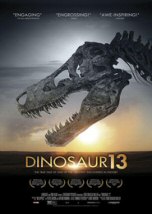
Dinosaur 13

   2014    Science
American paleontologist Pete Larson and his team discovered the largest and most complete Tyrannosaurus rex ever found (nicknamed 'Sue') while digging in the badlands of South Dakota. However the skeleton was seized from Larson by the federal government, followed by a ten-year-long battle with the FBI, the National Park Service, the Bureau of Indian Affairs, and Maurice Williams, on whose property the bones were discovered. Pete Larson also spent 18 months in prison." After the film aired, The Society of Vertebrate Paleontology, a society of professional academic paleontologists, issued a statement of full support for legally protecting fossils on public land and criticized Dinosaur 13 for implying that government regulations impede paleontological science
Let there be Life

   2014    Science
Professor of physics Jim Al-Khalili investigates the most accurate and yet perplexing scientific theory ever - quantum physics, the perplexing theory of sub-atomic particles. Turning his attention to the world of nature, can quantum mechanics explain the greatest mysteries in biology? The European robin navigates using one of the most bizarre effects in physics - quantum entanglement, a process which seems to defy common sense. Jim finds that even the most personal of human experiences - our sense of smell - is touched by ethereal quantum vibrations. According to new experiments it seems that our quantum noses are listening to smells. Jim discovers that the most famous law of quantum physics - the uncertainty principle - is obeyed by plants and trees as they capture sunlight during the vital process of photosynthesis. Jim wonders if the strange laws of the sub-atomic world, which allow objects to tunnel through impassable barriers in defiance of common sense, could effect the mechanism by which living species evolve?
Series: The Secrets of Quantum Physics

History of the World: Survival

   2012    History
Andrew Marr sets off on an epic journey through 70,000 years of human history. Using dramatic reconstructions, documentary filming around the world and cutting-edge computer graphics, he reveals the decisive moments that shaped the world we live in today, telling stories we thought we knew and others we were never told." Starting with our earliest beginnings in Africa, Marr traces the story of our nomadic ancestors as they spread out around the world and settled down to become the first farmers and townspeople. He uncovers extraordinary hand-prints left in European caves nearly 30,000 years ago and shows how human ingenuity led to inventions which are still with us today. He also discovers how the first civilisations were driven to extremes to try to overcome the forces of nature, adapting and surviving against the odds, and reveals how everyday life in ancient Egypt had more in common with today's soap operas than might be imagined.
Series: History of the World

Giants

   2000    Science
Be prepared to fight your way past all kinds of computer animation. Somehow Patrick Moore's The Sky at Night manages to convey just as much excitement with little more than a couple of diagrams and the presenter's hyperactive enthusiasm. The series cover the history of the solar system and humanity's age-old desire to learn its secrets. Far beyond the inner planets of rock and iron lie the gas giants. Discover the most distant and alien worlds in our Solar System and the moment of genius that allowed scientists to explore them.
Series: The Planets

To Fly or Not to Fly

   1998    Nature
The first episode looks at how birds first took to the skies in the wake of the insects. It begins in Mexico, where Sir Attenborough observes bats being outmanoeuvred by a red-tailed hawk. Pterosaurs were the birds' forerunners, some 150 million years after dragonflies developed the means of flight, but eventually went extinct together with the dinosaurs. Birds had by then already evolved from early forms like archaeopteryx, the first creature to possess feathers. Its ancestry can be traced through reptiles, and some current species, such as the flying lizard, possibly show paths this evolution may have taken." One of the biggest birds to have ever existed was the terror bird, which proliferated after dinosaurs vanished and stood up to 2.5 metres tall. By comparison, the ostrich, while not closely related, is the largest and heaviest living bird. It was probably the evasion of predators that drove most birds into the air, so their flightless cousins evolved because they had few enemies. Accordingly, such species are more likely to be found on islands, and Sir Attenborough visits New Zealand to observe its great variety, most especially the kiwi. Also depicted is the moa, another huge creature that is now gone. The takahē is extremely rare, and high in the mountains of New Zealand, Sir Attenborough discovers one from a population of only 40 pairs. Finally, another example on the brink of extinction is the kakapo, which at one point numbered only 61 individuals. A male is heard calling — an immensely amplified deep note that can be heard at great distances from its nest.
Series: The Life of Birds

The life of Buddha

   2003    History
Life of the Buddha is a major new landmark documentary following Buddha on his journey from the lap of luxury to the verge of starvation and final enlightenment. Shot on location in Nepal and India, Life of the Buddha uses dramatic computer-generated images and recent archaeological discoveries to piece together this remarkable story.
The Story of Us

The Story of Us

2018  Culture
Clarkson Farm 4

Clarkson Farm 4

2025  Nature
The Last Dance

The Last Dance

2020  Culture
Science and Islam

Science and Islam

2017  History
Enemies of Reason

Enemies of Reason

  Medicine