Octavian takes a new bride, Livia, and then introduces her to his family in a startling way... by having her witness the punishment he metes out to Atia and Octavia, for secretly defying the social constraints established through the facade of Octavia's marriage to Mark Antony. The vengeful Gaia carries out her plan to poison Eirene, which produces most dire consequences for Pullo, and no one else is the wiser. Meanwhile, Octavian, Antony, Maecenas, and their associates barely maintain their relationships of congenial contempt and hypocrisy, as everyone tries to figure out who has duped whom with the disappearance of the gold that was Herod's 'gift.'
Our relationship with destruction is not a simple one. It can release endorphins and relax our minds. It can amp us up and make us even more aggressive. It can even help us regulate our emotional reactions. Can violently breaking things calm us down? Or does it simply anger us more? Find out as Michael Stevens takes a look into our urge to destroy.
Here's a growing trend in artificial intelligence. Dating video games and other applications let users carry on virtual relationships with computerized girlfriends ranging from career women to Japanese schoolgirls. There's even something for the ladies. How soon will there be artificial intelligence of such complexity that protecting its well-being and rights becomes a serious political and social concern? In what year will there be an app or computer program or a device that you not only love but that possibly, within the realm of believability might actually love you ...back?
Following the wildly successful 'Cosmos: A Spacetime Odyssey,' Neil deGrasse Tyson returns as host to translate more revelations of science into a lavish transporting experience, taking audiences on a series of spiritual voyages of exploration. The show reveals previously uncharted realms, including lost worlds, worlds yet to come, and the worlds that humans may one day inhabit. Ann Druyan, original creative collaborator to Carl Sagan, whose iconic docuseries 'Cosmos' provided inspiration for this series, serves as executive producer alongside Seth MacFarlane. Episode 1 takes viewers on a wild ride with the Ship of Imagination in an adventure spanning billions of years into the evolution of life.
Episode 3 delves into how life began on a roiling, violent Earth and explores the story behind Victor Goldschmidt, the man who found the first clues to life's beginnings on our planet. Neil deGrasse Tyson takes viewers on a journey through space and time to witness the tenacity and creativity of life on Earth and the prospects of life throughout the universe.
At 11 o'clock on New Year's Eve of the Cosmic Calendar, Homo erectus stood up for the first time, freeing its hands and earning the species its name. They began to move around, to explore, daring to risk everything to get to unknown places. Our Neanderthal relatives lived much as we did and did many of the things we consider to be 'human.' More restless than their cousins the Neanderthals and Denisovans, our Homo sapiens ancestors crossed seas and unforgiving landscapes, changing the land, ocean and atmosphere, leading to mass extinction. The scientific community gave our age a new name, 'Anthropocene.' Since the first civilizations we've wondered if there's something about human nature that contains the seeds of our destruction. Syukuro Manabe was born in rural Japan and took an intense interest in Earth's average global temperature. In the 1960's, he would assemble the evidence he needed to predict the increase of Earth's temperature due to greenhouse gases until it becomes an uninhabitable and toxic environment, leading to our extinction. 'This doesn't have to be,' says Neil deGrasse Tyson, 'it's not too late. There's another hallway, another future we can still have; we'll find a way.'







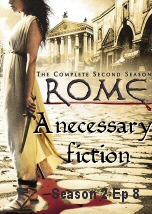





Meanwhile, Octavian, Antony, Maecenas, and their associates barely maintain their relationships of congenial contempt and hypocrisy, as everyone tries to figure out who has duped whom with the disappearance of the gold that was Herod's 'gift.'