




Last Watched

"Light"  Sort by

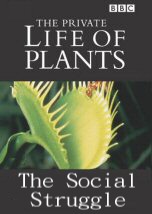
The Social Struggle

   1995    Nature
Fourth episode examines how plants either share environments harmoniously or compete for dominance within them. Attenborough highlights the 1987 hurricane and the devastation it caused. However, for some species, it was that opportunity for which they had lain dormant for many years. The space left by uprooted trees is soon filled by others who move relatively swiftly towards the light. The oak is one of the strongest and longest-lived, and other, lesser plants nearby must wait until the spring to flourish before the light above is extinguished by leaves. Tropical forests are green throughout the year, so brute force is needed for a successful climb to the top of the canopy: the rattan is an example that has the longest stem of any plant. As its name suggests, the strangler fig 'throttles' its host by growing around it and cutting off essential water and light. Some can take advantage of a fallen tree by setting down roots on the now horizontal trunk and getting nutriment from the surrounding moss and the fungi on the dead bark. The mountain ash (eucalyptus regnans) grows so tall, that regeneration becomes a considerable problem. It is easily flammable, so its solution is to shed its seeds during a forest fire and sacrifice itself. It therefore relies on the periodic near-destruction of its surroundings in order to survive. Attenborough observes that catastrophes such as fire and drought, while initially detrimental to wildlife, eventually allow for deserted habitats to be reborn.
Series: The Private Life of Plants
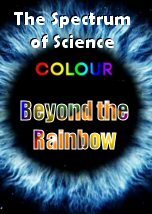
Beyond the Rainbow

   2015    Science
Helen Czerski ventures beyond the visible spectrum in the final (and best) episode in this vibrant series, showing how electromagnetic radiation is so much broader than the narrow slice of reality we see with our eyes. Before delving into the details of UV, infrared and x-rays, Dr Czerski explores colour subjectivity by trying on a dress that recently divided the internet — to some it appeared blue and black, to others white and gold. It's a perfect fit. It's also a neat analogy of how people can have opposing views but both swear blind that their perspective is correct. The series ends with some amazing imaging techniques that show our bodies in a whole new light.
Series: Colour The Spectrum of Science

How Big How Far How Fast

   2012    Science
Push the limits of your imagination as astronomers attempt to grasp the mind-boggling extremes of size, distance and speed within our universe by bringing them down to earth. In this episode, our cast uses awesome analogies to bring the biggest objects, farthest distances and fastest speeds down to earth. To truly understand the scale of the cosmos, we jump behind the wheel of monster trucks, scale the Golden Gate Bridge, and race across the desert in a rocket-powered car.
Series: The Universe

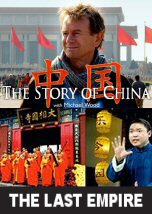
The Last Empire

   2016    History
China's last empire, the Qing, lasted from 1644 to 1912. It began in violence and war as the Manchus swept down from the north, but invaders became emperors, with three generations of one family ruling the country. Among them, Michael Wood argues, was China's greatest emperor - Kangxi. Under the Qing, China doubled in size to include Xinjiang in the far west, as well as Mongolia and Tibet, creating the essential shape of China today. The new dynasty tolerated a diversity of cultures and religions, including Islam. In Kaifeng, Michael visits a women's mosque with a female imam, a delightful scene that ends with laughter and selfies! The Qing also undertook huge cultural enterprises. At a traditional printing house where the wood blocks are hand-carved, we see how the Complete Tang Poems were reproduced - all 48,000 of them. We travel through the wintry countryside to a remote village where a hardy audience watch open-air opera in the snow and visit a painter's studio, and 'storytelling' houses in Yangzhou. In the 18th century, China was arguably the greatest economy in the world, and we get a fabulous sense of the rich culture that came with prosperity. But then came the clash with the British, in the first Opium War, when a British expedition destroyed the Qing navy and extracted territory and trading rights. We leave with a glimpse of the future. 'Every dynasty has risen and declined,' says Michael, 'and has needed new life to regenerate, and this time the catalyst was the British.' Among the ports China ceded was an almost uninhabited island, Hong Kong, one of today's greatest financial centres, and Shanghai, a small town then but now one of the greatest cities in world.
Series: The Story of China

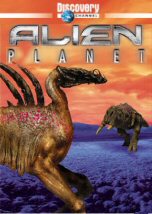
Alien Planet

   2005    Nature
The computer animated drama takes place on Darwin IV, a planet 6.5 light years from earth, with 2 suns and 60% of Earth's gravity. Earth sends a pilot mission with three probes. This robotic fleet is responsible for finding and assessing any life forms on Darwin IV. The probes soon find themselves in the middle of a developed ecosystem teeming with diversity of life of all sizes. "Alien Planet" is motivated by real science missions, such as the NASA Origins Program and the NASA / JPL Planet-Finder Mission, as well as the European Space Agency's Darwin Project. It is a cosmic expedition along side Stephen Hawking, Michio Kaku, Jack Horner, Craig Venter, and George Lucas, and NASA's Chief Scientist Jim Garvin. No longer just the domain of science fiction, "Alien Planet" dramatizes an exciting and possible answer to what alien life really looks like and when we'll find it.

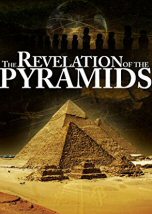
The Revelation of the Pyramids

   2010    History
An apocryphal view on the pyramids, starting in awe at the amazing achievement of the Pharaonic architecture and sculpture, most specially at Gizeh, given Cheops's pyramid's size, weight, incredibly precise carving, four pairs of slightly shifted half sides, stunningly precisely measured shapes and symmetry. Then it questions and challenges conventional Egyptology beliefs, which it calls unproven or even impossible to verify, such as the absence of machines, a wharf duration of only 20 years or accidental equinox-orientation. Next it elaborates the theory that other major pyramid technology sites in Precolombian America, Easter Island and China can't coincidentally lie on two lines intersecting at Gizeh, even if not contemporaneous and without known contacts in their ages, and have several improbable things in common, like some of their cultures. Elaborate mathematical theories and measurements indicate the Egyptians must have known some astronomy, pi and the golden number
Arnold

Arnold

2023  History
The Hunt

The Hunt

2015  Nature
Ancient Aliens

Ancient Aliens

2014  Culture
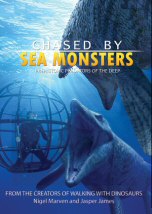
Chased by Sea Monsters

Chased by Sea Monsters

2003  Science
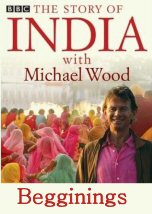
The Story of India

The Story of India

2007  History
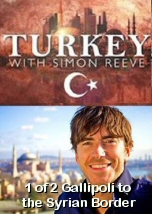
Turkey with Simon Reeve

Turkey with Simon Reeve

2017  Culture
The Truth About

The Truth About

2018  Medicine