
Last Watched

"Star"  Sort by

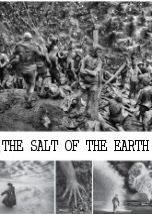
The Salt of the Earth

   2014    Art
For the last 40 years, the photographer Sebastião Salgado has been travelling through the continents, in the footsteps of an ever-changing humanity. He has witnessed some of the major events of our recent history; international conflicts, starvation and exodus. He is now embarking on the discovery of pristine territories, of wild fauna and flora, and of grandiose landscapes as part of a huge photographic project, which is a tribute to the planet's beauty". Sebastião Salgado's life and work are revealed to us by his son, Juliano, who went with him during his last travels, and by Wim Wenders, himself a photographer.
Who Is Afraid of a Big Black Hole

   2009    Science
Black Holes are one of the most destructive forces in the universe, capable of tearing a planet apart and swallowing an entire star. Yet scientists now believe they could hold the key to answering the ultimate question - what was there before the Big Bang? The trouble is that researching them is next to impossible. Black holes are by definition invisible and there's no scientific theory able to explain them. Meet the astronomers attempting to image a black hole for the very first time and the theoretical physicists getting ever closer to unlocking their mysteries. It's a story that takes us into the heart of a black hole and to the very edge of what we think we know about the universe.

Second Earth

   2015    Science
20 years ago, two astronomers made a remarkable discovery, one which would change the way we view the universe for ever. A planet outside our solar system, orbiting a distant star - an exoplanet. Since then, we have found worlds where it rains diamonds, ones that boil at 3,000 degrees centigrade and even a world with four suns in its sky. But the big question is - will we ever find another Earth? As we close in on the discovery of the 2,000th planet outside our solar system, or exoplanet, we investigates the techniques that are revealing so much about these alien worlds. The documentary asks if we are really any closer to finding another world like our own - a second Earth.
Series: The Sky at Night

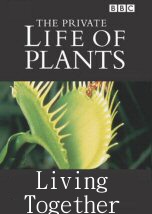
The Private Life of Plants Living Together

   1995    Nature
The fifth programme explores the alliances formed between the animal and plant worlds. Attenborough dives into Australia's Great Barrier Reef and contrasts the nocturnal feeding of coral, on microscopic creatures, with its daytime diet of algae. Some acacias are protected by ants, which will defend their refuge from any predator. Besides accommodation, the guards are rewarded with nectar and, from certain species, protein for their larvae as well. Fungi feed on plants but can also provide essential nutriment to saplings (Mycorrhiza). The connection is never broken throughout a tree's life and a quarter of the sugars and starches produced in its leaves is channelled back to its fungal partners. Meanwhile, fungi that feed on dead wood leave a hollow trunk, which also benefits the tree. Orchids enjoy a similar affiliation. Lichens are the product of a relationship between fungi and a photosynthetic associate, usually algae. They are extremely slow-growing, and a graveyard is the perfect location to discover their exact longevity. Mistletoe is a hemiparasite that obtains its moisture from a host tree, while using own leaves to manufacture food. Its seeds are deposited on another by the mistletoe tyrannulet, following digestion of the fruit. The dodder (Cuscuta) is also parasitic, generally favouring nettles, and siphons its nourishment through periodic 'plugs' along its stem. The rafflesia has no stem or leaves and only emerges from its host in order to bloom — and it produces the largest single flower: one metre across.
Series: The Private Life of Plants

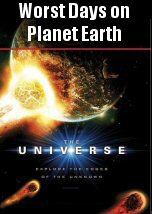
Worst Days on Planet Earth

   2011    Nature    3D    HD
Earth may seem like the most hospitable planet in the solar system. But look again. Startling new discoveries reveal the blue planet has been plagued by more chaos and destruction than scientists once imagined. Stand on the Earth billions of years ago as a primitive planet called Theia slams into it. Shiver as our entire globe is frozen over like a gigantic snowball. Feel the heat as mammoth volcanoes scorch the landscape and darken the sky. From a cosmic gamma ray burst frying away the ozone layer to an Everest-size asteroid slamming into the ocean, we'll reveal new information about how these unparalleled events drove life to the brink of total extinction. Out of this continuous devastation, how has our planet--and life--got to where it is today? Are the worst days behind us--or lurking in the distant future?
Series: The Universe

How Big How Far How Fast

   2012    Science
Push the limits of your imagination as astronomers attempt to grasp the mind-boggling extremes of size, distance and speed within our universe by bringing them down to earth. In this episode, our cast uses awesome analogies to bring the biggest objects, farthest distances and fastest speeds down to earth. To truly understand the scale of the cosmos, we jump behind the wheel of monster trucks, scale the Golden Gate Bridge, and race across the desert in a rocket-powered car.
Series: The Universe
Leaving Neverland

Leaving Neverland

2019  Culture
Ancient Apocalypse

Ancient Apocalypse

2024  History
The Climate Wars

The Climate Wars

  Nature
The Crime of the Century

The Crime of the Century

2021  Medicine
Dinosaur Planet

Dinosaur Planet

2003  Science
X-Ray Earth

X-Ray Earth

2021  Science
The Life of Mammals

The Life of Mammals

2002  Nature