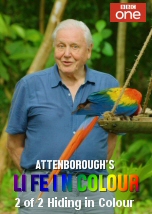
David Attenborough reveals the extraordinary ways that some animals use colour to hide and disappear into the background. New science reveals how the Bengal tiger in central India uses its orange-black stripes to hide from its colour-blind prey. In Kenya’s Masai Mara, the zebra’s black-and-white pattern confuses predators with an extraordinary effect called motion dazzle. And on the island of Cuba, a small snail uses colourful stripes in a surprising way to hide from its enemies. Other animals use colour to trick and to deceive. On Australia’s Great Barrier Reef, a blue-striped blenny uses colours to mimic other fish and launch a sudden attack. In the grasslands of Zambia, the chick of a pin-tailed whydah mimics the patterns of its nest mates to ensure that it is not detected as an imposter. And specialist cameras reveal how a tiny crab spider uses bright ultraviolet colours to lure in its victims.
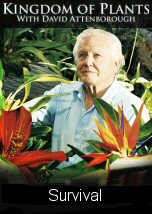
From the frozen poles to the searing deserts, this episode shows how animals have come up with strategies to survive the uneven amounts of sunlight that fall on our planet over the course of a year. The exception is on the equator, where the duration of day and night remain the same throughout the year. Here, this guaranteed sunlight drives the great diversity of life in the tropical jungles.
Ma Anand Sheela and several other followers recount their experiences of moving to the ranch and the hostility from the residents of the city of Antelope. With the help of architects, engineers, city planners and commune residents, Rajneeshees construct a town called Rajneeshpuram. The commune decides to become self-governing which would allow them to issue their own building permits and have separate law enforcement. Locals describe their mistrust towards Bhagwan. The American press begins to affiliate Rajneeshpuram with the Jonestown Massacre and paints Bhagwan as an antichrist. The group '1000 Friends of Oregon' initiates a court case to have the buildings of Rajneeshpuram destroyed. In response, Sheela begins buying up available properties in Antelope.
Michelle McNamara reflects on the 1984 murder of her childhood neighbour Kathy Lombardo, which she credits with planting the seed for her lifelong fascination with unsolved crimes. Michelle really wanted this child and wished to get her murderer caught. The story of the victims has to be told.
In 1979, law enforcement is thrilled when the East Area Rapist attacks abruptly stop in Northern California. But in reality, the East Area Rapist had only moved 400 miles south, to commit a number of gruesome murders in the Santa Barbara area, where he would become known as the Original Night Stalker. Michelle McNamara ultimately came up with the name 'Golden State Killer' cause he terrorized up and down the state. Michelle starts to write a true crime book that would transcend the genre because the way she humanized all of the victims.
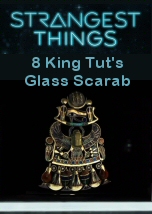
The jeweled-encrusted pectoral of King Tut is a hieroglyphic artefact of stunning craftsmanship and one of the greatest treasures of the pharaohs. Was this ancient glass scarab in Tutankhamun's tomb created by forces from beyond our world? Using new research and the latest tech, experts confront the ancient mystery of its flawless glass scarab. Is a 4,000 year old clay tablet the original instruction manual for Noah's ark? And how can a bizarre red moon rock contain signs of life?

















Other animals use colour to trick and to deceive. On Australia’s Great Barrier Reef, a blue-striped blenny uses colours to mimic other fish and launch a sudden attack. In the grasslands of Zambia, the chick of a pin-tailed whydah mimics the patterns of its nest mates to ensure that it is not detected as an imposter. And specialist cameras reveal how a tiny crab spider uses bright ultraviolet colours to lure in its victims.