


Last Watched

"NES"  Sort by

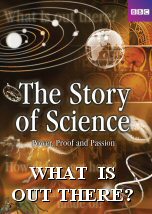
What Is Out There

   2010    History
An informative and ambitious journey exploring how the evolution of scientific understanding is intimately interwoven with society's historical path. The Story Of Science tells the forces that came together to create scientific knowledge; the practical business of making instruments and machines; the great forces of history – revolutions, voyages of discovery and artistic movements – and the dogged determination of scientists and experimenters. This is the story of how scientific ideas shaped the modern world and how science made history. Michael Mosley begins the first episode with the story of one of the great upheavals in human history - how we came to understand that our planet was not at the centre of everything in the cosmos, but just one of billions of bodies in a vast and expanding universe. He reveals the critical role of medieval astrologers in changing our view of the heavens, and the surprising connections to the upheavals of the Renaissance, the growth of coffee shops and Californian oil and railway barons. Michael shows how important the practical skills of craftsmen have been to this story and finds out how Galileo made his telescope to peer at the heavens and by doing so helped change our view of the universe forever.
Series: The Story of Science
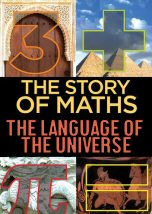

The Story of Maths The Language of the Universe

   2008    Science
This four-part British television series outlines aspects of the history of mathematics. Written and presented by University of Oxford professor Marcus du Sautoy, it is a co-production between the Open University and the BBC. In the first episode, Marcus du Sautoy in Egypt uncovers use of a decimal system based on ten fingers of the hand and discovers that the way we tell the time is based on the Babylonian Base 60 number system. In Greece, he looks at the contributions of some of the giants of mathematics including Plato, Archimedes and Pythagoras, who is credited with beginning the transformation of mathematics from a counting tool into the analytical subject of today. A controversial figure, Pythagoras’ teachings were considered suspect and his followers seen as social outcasts and a little be strange and not in the norm. There is a legend going around that one of his followers, Hippasus, was drowned when he announced his discovery of irrational numbers. As well as his work on the properties of right angled triangles, Pythagoras developed another important theory after observing musical instruments. He discovered that the intervals between harmonious musical notes are always in whole number intervals.
Series: The Story of Maths

McLaren

   2017    History
The inspirational documentary account of one man’s pioneering spirit, unswerving tenacity and endless passion, McLaren is the untold story of a motor racing icon. Born in New Zealand in 1937, Bruce McLaren’s determination to make it to the summit of global motor racing circles saw his name become synonymous with the sport; displaying an incomparable will to succeed and desire to better both himself and his burgeoning super brand.
In following a singular dream, McLaren elicited the loyalty, determination and love of family, friends and colleagues to create a dynasty that lives on to this day. Revealing the challenges and adversities faced along the way, including a childhood illness which threatened to alter the path of his life, McLaren is the story of one man’s unfaltering commitment to his vision which will inspire generations of sporting fans.

Dinosaurs Myths and Monsters

   2011    Science
From dinosaurs to mammoths, when our ancient ancestors encountered the fossil bones of extinct prehistoric creatures, what did they think they were? Just like us, ancient peoples were fascinated by the giant bones they found in the ground. Historian Tom Holland goes on a journey of discovery to explore the fascinating ways in which our ancestors sought to explain the remains of dinosaurs and other giant prehistoric creatures, and how bones and fossils have shaped and affected human culture.
In Classical Greece, petrified bones were exhibited in temples as the remains of a long-lost race of colossal heroes. Chinese tales of dragons may well have had their origins in the great fossil beds of the Gobi desert. In the Middle Ages, Christians believed that mysterious bones found in rock were the remains of giants drowned in Noah's Flood.
Tom encounters a medieval sculpture that is the first known reconstruction of a monster from a fossil, and learns about the Native Americans stories, told for generations, which contained clues that led bone hunters to some of the greatest dinosaur finds of the nineteenth century.

The Kingdom How Fungi Made Our World

   2018    Science
You find fungi in Antarctica and in nuclear reactors. They live inside your lungs and your skin is covered with them. Fungi are the most under appreciated and unexplained organisms, yet they could cure you from smallpox and turn cardboard boxes into forests. They could even transform Mars into Eden. There are vastly more fungi species than plants and each and every one of them plays a crucial role in life’s support systems. Join us on a journey into the mysterious world of Fungi to witness their beauty, unravel their mysteries and discover how this secret kingdom is essential to life on Earth, and may in fact hold the key to our future.

Rats

   2016    Culture
The film goes deep beneath the surface to explore the lives of man's greatest parasite. Morgan Spurlock unveils a new form of documentary horror storytelling, journeying around the world to bring viewers face to face with rats while delving into our complicated relationship with these creepy creatures. Taking us into the rats nests in ways never before captured on film, RATS dives deep into New York City's parks, subway tunnels, and sewers; venture to rice paddies in Cambodia and Vietnam where rats are caught and sold as food, cross worldly streets in India paroled by the revered Night Rat Killers, journey to English countryside where packs of terriers kill hundreds of rats per day, and look inside a New Orleans lab, where scientists are studying how flooding and abandoned neighbourhoods are making rats more invasive than ever.