






Last Watched

"Ant "  Sort by

The Private Life of Plants Living Together

   1995    Nature
The fifth programme explores the alliances formed between the animal and plant worlds. Attenborough dives into Australia's Great Barrier Reef and contrasts the nocturnal feeding of coral, on microscopic creatures, with its daytime diet of algae. Some acacias are protected by ants, which will defend their refuge from any predator. Besides accommodation, the guards are rewarded with nectar and, from certain species, protein for their larvae as well. Fungi feed on plants but can also provide essential nutriment to saplings (Mycorrhiza). The connection is never broken throughout a tree's life and a quarter of the sugars and starches produced in its leaves is channelled back to its fungal partners. Meanwhile, fungi that feed on dead wood leave a hollow trunk, which also benefits the tree. Orchids enjoy a similar affiliation. Lichens are the product of a relationship between fungi and a photosynthetic associate, usually algae. They are extremely slow-growing, and a graveyard is the perfect location to discover their exact longevity. Mistletoe is a hemiparasite that obtains its moisture from a host tree, while using own leaves to manufacture food. Its seeds are deposited on another by the mistletoe tyrannulet, following digestion of the fruit. The dodder (Cuscuta) is also parasitic, generally favouring nettles, and siphons its nourishment through periodic 'plugs' along its stem. The rafflesia has no stem or leaves and only emerges from its host in order to bloom — and it produces the largest single flower: one metre across.
Series: The Private Life of Plants
Worst Days on Planet Earth

   2011    Nature    3D    HD
Earth may seem like the most hospitable planet in the solar system. But look again. Startling new discoveries reveal the blue planet has been plagued by more chaos and destruction than scientists once imagined. Stand on the Earth billions of years ago as a primitive planet called Theia slams into it. Shiver as our entire globe is frozen over like a gigantic snowball. Feel the heat as mammoth volcanoes scorch the landscape and darken the sky. From a cosmic gamma ray burst frying away the ozone layer to an Everest-size asteroid slamming into the ocean, we'll reveal new information about how these unparalleled events drove life to the brink of total extinction. Out of this continuous devastation, how has our planet--and life--got to where it is today? Are the worst days behind us--or lurking in the distant future?
Series: The Universe

Beyond the Rainbow

   2015    Science
Helen Czerski ventures beyond the visible spectrum in the final (and best) episode in this vibrant series, showing how electromagnetic radiation is so much broader than the narrow slice of reality we see with our eyes. Before delving into the details of UV, infrared and x-rays, Dr Czerski explores colour subjectivity by trying on a dress that recently divided the internet — to some it appeared blue and black, to others white and gold. It's a perfect fit. It's also a neat analogy of how people can have opposing views but both swear blind that their perspective is correct. The series ends with some amazing imaging techniques that show our bodies in a whole new light.
Series: Colour The Spectrum of Science

Born to Be Wild

   2011    Nature    3D    HD
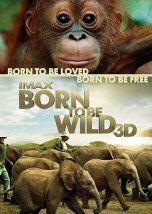
Born to be Wild is an inspiring story of love, dedication and the remarkable bond between humans and animals. This film documents orphaned orangutans and elephants and the extraordinary people who rescue and raise them - saving endangered species one life at a time. Stunningly captured in IMAX 3D and Narrated by Academy-Award winner Morgan Freeman, 'Born to be Wild' is a heart-warming adventure transporting moviegoers into the lush rainforests of Borneo with world-renowned primatologist Dr. Birut‚ Mary Galdikas, and across the rugged Kenyan savannah with celebrated elephant authority Dame Daphne M. Sheldrick, as they and their teams rescue, rehabilitate and return these incredible animals back to the wild.

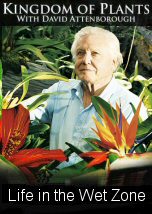
Kingdom of Plants Life in the Wet Zone

   2012    Nature
Written and presented by David Attenborough, who said: 'One of the most wonderful things about filming plants is that you can reveal hidden aspects of their lives, you can capture the moment as one plant strangles another, and as they burst into flower. But whilst time-lapse photography allows you to see things that no human being has ever seen before". David begins his journey inside the magnificent Palm House, a unique global rainforest in London. Here, he explores the extraordinary plants that are so well adapted to wet and humid environments and unravels the intimate relationships between wet zone plants and the animals that depend on them. It was in the wet zones of the world that plants first moved on to land and in the Waterlily House David reveals how flowers first evolved some 140 million years ago. Watching a kaleidoscope of breath-taking time-lapses of these most primitive of flowers swelling and blooming in 3D, he is able to piece together the very first evolutionary steps that plants took to employ a wealth of insects to carry their precious pollen for the first time. David discovers clues to answer a question that even had Charles Darwin stumped: how did flowering plants evolve so fast to go on to colonise the entire planet so successfully?
Series: Kingdom of Plants

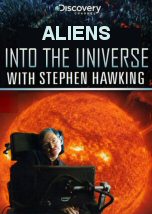
Aliens

   2010    Nature    HD
Stephen Hawking, the world's most famous living scientist explores the greatest mysteries of the cosmos. In three landmark instalments he reveals the wonders of the universe as never seen before. Definitive, provocative, surprising, and beautiful, Into the Universe with Stephen Hawking is a fascinating look through the mind's eye of one of the finest brains on the planet. In 'Aliens' Hawking considers one of the most important mysteries facing humankind - the possibility of alien, intelligent life. He leads us on a journey rendered in eye-popping detail, from the moons of Jupiter to a galaxy maybe not so far, far away. We will meet possible aliens and wonder at their form, we will delve into the very principles of what it is to call something alive, and we will calculate the likelihood of 'contact' being made.
Series: Into The Universe with Stephen Hawking