






Last Watched

"Car"  Sort by

Mars: the New Evidence

   2010    Science
In the last few years, the Red Planet has yielded up many new clues that life may have once existed there...and may even exist there today. There is now have proof that water once flowed on the surface, that Mars once had lakes, and that the frozen poles are mostly water, not carbon dioxide as previously thought. Mars has snow--an aurora--and lightning generated by dust storms. Most intriguing of all are the seasonal plumes of methane that just may point to bacteria living below the surface.
Series: The Universe
The Inner Planets: Mecury and Venus

   2007    Science
Scorched by their proximity to the sun, Mercury and Venus are hostile worlds; one gouged with craters from cosmic collisions and the other a vortex of sulphur, carbon dioxide and acid rain. Prime examples of planets gone awry, do they serve as a warning for ominous scenarios that might someday threaten Earth?
Series: The Universe

The Most Dangerous Place in the Universe

   2007    Science
Take a tour of the cosmic hot zones--black holes, galaxy mergers, gamma ray bursts and magnetars. Super black holes can literally lasso Earth out of the solar system. A clash between two galaxies can result in a ritual called galactic cannibalism. Magnetars are a cosmic magnetic force so strong it could wipe out data on every credit card.
Series: The Universe

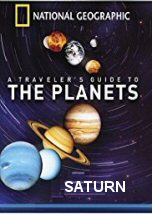
Saturn

   2011    Science
No planet beats Saturn for jaw-dropping beauty. Saturn is the most photogenic planet in all the solar system. Some of the pictures are to die for. But the postcards only tell part of the story. It really is rolling and seething inside. For ringside action, soar above the planet with its six-sided storms. Even more mystery surrounds the impressive Fountains of Enceladus where the secrets of life might spring from the moons salty geysers. And the samples are coming out in space, there's a big sign there: Free Samples: Take One.
Series: A Traveler Guide to the Planets

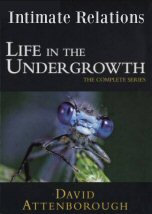
Intimate Relations

   2005    Nature
The world of invertebrates exists in a web of relationships with plants and other animals. Unique footage of the world's smallest insect (a fairy wasp only quarter of a millimetre long) shows it flying underwater to find the eggs of water beetles in which to lay its own brood. Some ants 'farm' the trees that give them shelter, creating areas known as 'Devil's gardens'. To make sure these grow without competition, they kill off other seedlings in the surrounding vegetation. The blister beetle's larvae huddle together on the end of a piece of grass and mimic a female bee. When a male bee tries to mate with the 'female', the larvae grab on to his belly. Confused, he flies away and searches for a real female. When he eventually finds her and mates with her, the beetle larvae hurriedly swap from his front on to her back, and hence get carried back to her nest where they eat her pollen supplies.
Series: Life in the Undergrowth

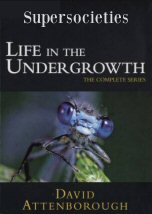
Supersocieties

   2005    Nature
Invertebrates don't always operate alone. True society was the last feature to evolve in invertebrates, as recently as the time of Tyrannosaurus. In the last programme see the tensions below the surface in some of the great social structures built by insects, and witness the carnage when an ant colony and a termite colony wage war.
Series: Life in the Undergrowth
Marilyn and the Mob

Marilyn and the Mob

2026  History
Rafa

Rafa

2026  History
D-Day

D-Day

2013  History
Shine a Light

Shine a Light

2008  Art
Planet Earth

Planet Earth

2007  Nature
Leaving Neverland

Leaving Neverland

2019  Culture
Omnivore

Omnivore

2024  Culture