

Last Watched

"Car"  Sort by

City Maps

   2010    Culture
This is the story of three maps, three 'visions' of London over three centuries. The Morgan Map of 1682 was the first to show the whole of the City of London after the Great Fire of London. In 1746 John Rocque produced at the time the most detailed map ever made of London. Like Morgan's, Rocque's map is all neo-Classical beauty and clinical precision, but the London it represented had become the opposite. In engravings of the time, such as Night, the artist William Hogarth shows a city boiling with vice and corruption. Stephen Walter's contemporary image, The Island, plays with notions of cartographic order and respectability. His extraordinary London map looks at first glance to be just as precise and ordered as his hero Rocque's but, looking closer, it includes 21st century markings such as 'favourite kebab vans' and sites of 'personal heartbreak'.
Series: The Beauty of Maps
Cartoon Maps

   2010    Culture
The series concludes by delving into the world of satirical maps. How did maps take on a new form, not as geographical tools, but as devices for humour, satire or storytelling? Graphic Artist Fred Rose perfectly captured the public mood in 1880 with his General Election maps featuring Gladstone and Disraeli, using the maps to comment upon crucial election issues still familiar to us today. Technology was on the satirist's side with the advent of high-speed printing allowing for larger runs at lower cost. In 1877, when Rose produced his 'Serio Comic Map of Europe at War', maps began to take on a new direction and form, reflecting a changing world. Rose's map exploited these possibilities to the full using a combination of creatures and human figures to represent each European nation. The personification of Russia as a grotesque-looking octopus, extending its tentacles around the surrounding nations, perfectly symbolised the threat the country posed to its neighbours.
Series: The Beauty of Maps
Bhutan to the Bay of Bengal

   2004    Culture
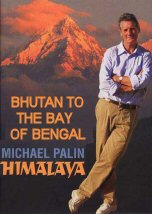
In Bhutan, Palin finds himself back in the land of yaks for a last look at the high Himalaya. Trekking to Chomolhari base camp he meets a nomad with a penchant for yak songs before heading down to Paro to witness the Buddhist festival or Tsechu. In a bar in Thimphu, he discusses reincarnation and the pursuit of happiness with Benji and Khendum, two of the king's cousins, and en route to Bangladesh is taken by Benji to see the rare black-neck cranes. On his journey south through Bangladesh, Michael visits the ship-breaking beaches of Chittagong and grid-locked Dhaka. He meets a man who made a fortune in Birmingham in the poultry business, and a woman who lends money only to women. On a 1920s paddle steamer he is serenaded with the words of Bengal's Shakespeare, and he completes his epic Himalayan journey aboard a fishing boat that carries him out into the Bay of Bengal and a westering sun.
Series: Himalaya with Michael Palin

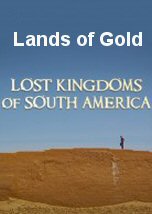
Lands of Gold

   2013    History
Through the mountains and jungles of Colombia, Cooper goes in search of the truth behind one of the greatest stories ever told - the legend of El Dorado. His journey takes him from Bogota to the Caribbean coast, through territories once dominated by two cultures, the Muisca and the Tairona, who flourished for centuries before the arrival of the Spanish in the 16th century. Cooper reveals forgotten peoples who valued gold in a way the Western world still struggles to understand, travelling to an astonishing lost city and meeting the last survivors of an ancient civilisation.
Series: Lost Kingdoms of South America

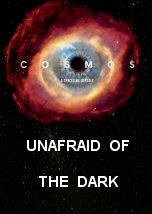
Unafraid of the Dark

   2014    Science
Tyson describes the discovery of cosmic rays by Victor Hess through high-altitude balloon trips. Swiss Astronomer Fritz Zwicky, in studying supernovae, postulated that these cosmic rays originated from these events instead of electromagnetic radiation. Also tells how Vera Rubin observed that the rotation of stars at the edges of observable galaxies did not follow expected rotational behavior leading to consider the existence of dark matter. This further led to the discovery of dark energy to account for the increasing rate of expansion of the universe. Tyson then describes the interstellar travel of the two Voyager probes. Tyson tells the Carl Sagan's role in the Voyager program, including creating the Voyager Golden Record to encapsulate humanity and Earth's position in the universe. Tyson concludes the series by emphasizing Sagan's message on the human condition in the vastness of the cosmos, and to encourage viewers to continue to explore and discover what else the universe has to offer.
Series: Cosmos: A Spacetime Odyssey

Easy Listening

   2013    Art
Series concludes with the focus shifting to the United States in the post-war years of the 1950s and beyond. Beginning with arguably the most notorious work of 20th century classical music, John Cage's 'silent' composition 4'33", it looks at how a series of maverick Americans re-invented the sound of classical music into a more simple form, bringing back harmonies and rhythms that made it increasingly popular with audiences across the world. It also examines how this music found its way into a spiritual realm, with the strain of pared-down religious composition that came to be known as 'holy minimalism'. From the Maverick concert hall in Woodstock, New York to an Orthodox cathedral in Estonia to a car park in Peckham, south London, the story is told by a stellar line-up of contributors including Philip Glass, Steve Reich, John Adams, Arvo Pärt and John Tavener.
Series: The Sound and the Fury
The Rehearsal Season 2

The Rehearsal Season 2

2025  Culture
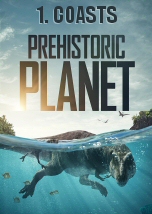
Prehistoric Planet

Prehistoric Planet

2022  Science
Rafa

Rafa

2026  History
Unknown

Unknown

2023  Technology
Tiger

Tiger

2020  History
Mind Field Season 2

Mind Field Season 2

2018  Technology