









Last Watched

"Planet"  Sort by

Frozen Worlds

   2019    Nature    HD
The polar regions of our planet may seem beyond the reach of most of us, but they are not beyond our influence. We, unintentionally, are changing these frozen worlds, and these changes will not just affect the poles but the whole planet. On the unforgiving frontier of climate change, polar bears, walruses, seals and penguins find their icy Edens in peril.
Series: Our Planet
From Deserts to Grasslands

   2019    Nature    HD
A fifth of the land on our planet is covered by desert. Deserts may appear to be barren and empty, but they are of crucial importance to life. For those that can overcome their challenges they provide a vital refuge. The Grasslands are one of our planet's most productive landscapes. They support the greatest aggregations of large animals on Earth. Cameras follow desert elephants seeking sustenance, bison roaming North American grasslands and caterpillars living the good life underground.
Series: Our Planet

Fresh Water

   2019    Nature    HD
Everything that lives on land, animal or plant, depends on fresh water. Yet only part of it is within reach: Much of the planet's fresh water, is locked away, almost two-thirds of it lies frozen around the poles. Even away from the poles, much of the land's fresh water freezes each winter. The need for fresh water is as strong as ever. However, the supply is becoming increasingly unpredictable and uncertain for all manner of species. We are not alone in our need for water, but we have the ability to ensure the fresh waters of the world do flow, and we alone can determine how they are shared.
Series: Our Planet

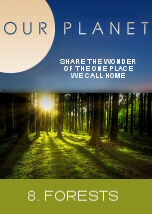
Forests

   2019    Nature    HD
The last episode examines the fragile interdependence that exists between forests' wide variety of residents, including bald eagles, hunting dogs and Siberian tigers.
Over half of all the world's trees, evergreen and deciduous, stand in great assemblies. For many of us, they are places of mystery and darkness. They are key to our climate, and home to countless unique species. The boreal forest contains 750 billion trees, and it stores over 40 percent of the world's carbon, making it a vital element in the fight against climate change. In the past, we have destroyed them without hesitation. Yet, forests do have an astonishing ability to recover. If we choose to give forests time and space, they could reclothe the earth with much of the rich and varied communities of animals and plants of which we have, so recently, robbed it. A future with more forests is key to the resilience of our planet.
Series: Our Planet

Exploring The Universe

   2020    Science
This remarkable science-history series investigates the blistering pace of human endeavour in space exploration, computing, energy, resources, Earth science and our understanding of the evolution of life itself. Across the last 50 years, humans have set a blistering pace and scientific discovery. We've crossed the boundaries of our solar system, made machines that can learn harnessed the power of the sun and built life from scratch. It's a period like no other in history, where human endeavour is changing everything: this is The Great Acceleration. As we race toward the future, we must examine the journey.
In the first episode, Dr Shalin Naik explores the ambitious space shuttle mission that began in the '70s plus the future colonization of Mars. Over the past 50 years, space has become central to everything, from communications to entertainment to climate modelling. And as private enterprise enters space exploration, our understanding of the universe will only continue to expand. We will know if we can survive on other objects - the moon, maybe Mars, maybe even some of the moons of Jupiter and Saturn. Deep space is the last and infinite frontier. That's what we do as human beings. We explore, we learn, we make discoveries, from the moment we're born to the moment we die.
Series: The Great Acceleration

Blue Marble

   2020    Nature
The Blue Marble is an image of Earth taken on 1972, from a distance of about 18,000 miles from the planet's surface. It was taken by the crew of the Apollo 17 spacecraft on its way to the Moon. Before it was photographed from space, our perspective of Earth was fragmented and disconnected. Recent discoveries have revealed a dynamic and rapidly changing planet, above the crust and below.
Series: The Great Acceleration
Earthflight

Earthflight

2012  Nature
Welcome to Earth

Welcome to Earth

2021  Nature
The Universe Season 8

The Universe Season 8

2016  Science
The Art of Russia

The Art of Russia

2009  Art
Leaving Neverland

Leaving Neverland

2019  Culture
History of the Eagles

History of the Eagles

2013  History