



Last Watched

"Sea"  Sort by

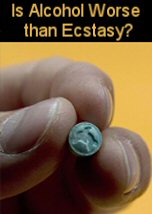
Is Alcohol Worse than Ecstasy

   2008    Medicine
The drug policies have remained unchanged over the last 40 years so should they be reformed in the light of new research? Recent research has analysed the link between the harmful effects of drugs relative to their current classification by law with some startling conclusions. Perhaps most startling of all is that alcohol, solvents and tobacco (all unclassified drugs) are rated more dangerous than ecstasy, 4-MTA and LSD (all class A drugs).
Chemistry: Discovering the Elements

   2010    Science
Just 92 elements made up the world, but the belief that were only four - earth, fire, air and water - persisted until the 19th Century. Professor Al-Khalili retraces the footsteps of the alchemists who first began to question the notion of the elements in their search for the secret of everlasting life.He reveals the red herrings and rivalries which dogged scientific progress, and explores how new approaches to splitting matter brought us both remarkable elements and the new science of chemistry.
Series: Chemistry

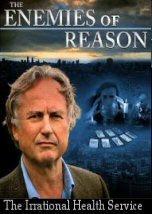
The Irrational Health Service

       Medicine
Richard Dawkins examines the growing suspicion the public has for science-based medicine, despite its track record of successes like the germ theory of disease, vaccines, antibiotics and increased lifespan. He notes a fifth of British children are currently not immunised against measles, mumps and rubella, attributing it to fears arising from a highly controversial report linking the vaccine with autism. Dawkins criticizes the growing field of alternative medicine which does not pass the same objective and statistical rigour as scientifically derived treatments using controlled double-blind studies. Without verifiable evidence, alternative therapies must rely on biased anecdotes and word of mouth to perpetuate. Dawkins observes these treatments have fanciful rationales and rituals behind them, with many alternative treatments employing pseudoscientific jargon such as "energy", "vibration" or "quantum theory" to give themselves greater credence to patients.
Series: Enemies of Reason

Hunger at Sea

   2015    Nature
Hunger at Sea follows blue whales, sharks, sea lions, frigatebirds, dolphins and albatrosses to reveal the strategies they use to hunt for prey in the big blue. The open ocean is an immense wilderness that covers more than half the surface of our planet, yet for the most part it's a watery desert, largely devoid of life. Predators face an endless search to find and catch food, yet these great tracts of ocean are home to some of the most remarkable hunters on the planet.
Series: The Hunt

Race Against Time. Coasts

   2015    Nature
The coast is the dynamic border between land and sea; powered by the tides and thrashed by waves, this is a world of continuous change. Opportunities never last long here, so hunters are always in a race against time. The coast is the only place on the planet where predators from air, land and sea come together. Dolphins that leave the safety of the sea to fish, walking octopuses, ingenious monkeys, fishing wolves and the greatest gathering of feeding humpback whales come to the coast to hunt. For all, timing is everything.
Series: The Hunt

In the Grip of the Seasons

   2015    Nature
The second episode looks at the challenges of hunting in the Arctic, the most seasonal place on Earth. To a predator, seasonal change is a problem. It means that all the parameters of the hunt - the conditions, the strategies, the prey - change too. The only option for the Arctic's top predators, the wolf, the Arctic fox and the polar bear, is to continually adapt to their changing world, exploiting the good times and enduring the bad.
Series: The Hunt
Ancient Rome

Ancient Rome

2006  History
Human

Human

2025  History
Ice Age Giants

Ice Age Giants

2013  Science
The Art of Germany

The Art of Germany

2010  Art
Life

Life

2009  Nature
Bronze Age

Bronze Age

2016  History
Top Gear

Top Gear

2012  Technology